NAVI Titanium supplies surron ultra bee titanium bolts for motorcycle assembly, modification, and replacement requirements where accurate specifications and reliable fastening are essential. International business personnel coordinate RFQs, technical drawings, thread standards, quantity breaks, and export documentation with overseas buyers, reducing communication gaps during multi-specification orders. A project-based team brings sales, engineering, machining, inspection, and logistics personnel into the same workflow, allowing unusual head forms, thread combinations, surface treatments, or mixed-size kits to be reviewed collectively. This structure is particularly useful for distributors and workshops managing recurring customized orders.


Solutions of NAVI Titanium
NAVI Titanium combines international sales coordination with a project-based technical team for motorcycle fastening component programs and customized hardware requirements. Rather than assigning every inquiry to a single sales contact, project members from sales, engineering, machining, inspection, and logistics can participate according to the order stage. This arrangement is useful for distributors and modification workshops requiring mixed specifications, recurring batches, or less-common configurations.


NAVI Titanium applies titanium fastening component engineering to motorcycle joints where thread precision, dimensional conformity, clamping behavior, and mass reduction require coordinated consideration. Material grade selection, machining accuracy, thread geometry, and surface condition are evaluated as an integrated specification, particularly for suspension, foot-control, handlebar, and accessory mounting points exposed to cyclic vibration and mechanical loading.


Application
Surron ultra bee titanium bolts from NAVI Titanium are suited to suspension, footpeg, handlebar, control, and accessory mounting areas where accurate fit, reduced mass, corrosion resistance, and dependable fastening are important.
Titanium fastening hardware used around the suspension and foot-control zones are exposed to repeated vibration, impact loading, cyclic torque, and contamination from mud or water. Typical locations include linkage connections, footpeg brackets, axle-related clamping points, fork hardware, and supporting chassis joints. These interfaces require more than dimensional compatibility: thread engagement, clamping force, head geometry, and tightening procedure must correspond with the original assembly design. Grade 5 Ti is often selected where reduced mass and corrosion resistance are valued, particularly for off-road platforms operating under wet or abrasive conditions. The lower density of titanium can reduce fastening component mass without requiring a change in the surrounding structural arrangement. However, Ti-alloy fastening hardware should not be treated as direct substitutes for every factory fastening component; joint load, thread condition, friction coefficient, and torque requirements need to be reviewed before installation. For buyers, batch consistency, CNC thread accuracy, surface condition, dimensional traceability, and compatibility with the specified assembly are important purchasing parameters.

2. Handlebar, Control Components and Accessory Mounting

Fastening components around the cockpit serve numerous relatively compact but mechanically important interfaces, including handlebar mounts, lever assemblies, throttle components, switch housings, dashboard brackets, cable clamps, guards, and accessory supports. These joints experience repeated manual operation, vibration, steering movement, and occasional impact, making thread accuracy and controlled clamping particularly important. The Ultra Bee control architecture incorporates brake levers, switches, throttle-related components, and other handlebar-mounted functions, while aftermarket configurations may introduce risers, guards, auxiliary brackets, or replacement controls. Ti-alloy hardware can be considered where weight reduction, corrosion resistance, and a consistent mechanical finish are procurement priorities. For commercial buyers, attention should extend to thread pitch, effective length, head type, washer compatibility, seating geometry, and installation torque rather than material designation alone. Maintaining these parameters across production batches helps reduce assembly variation and simplifies replacement-part management. For mixed orders, individually identified specifications can also reduce errors when multiple fastener lengths and head forms are required.
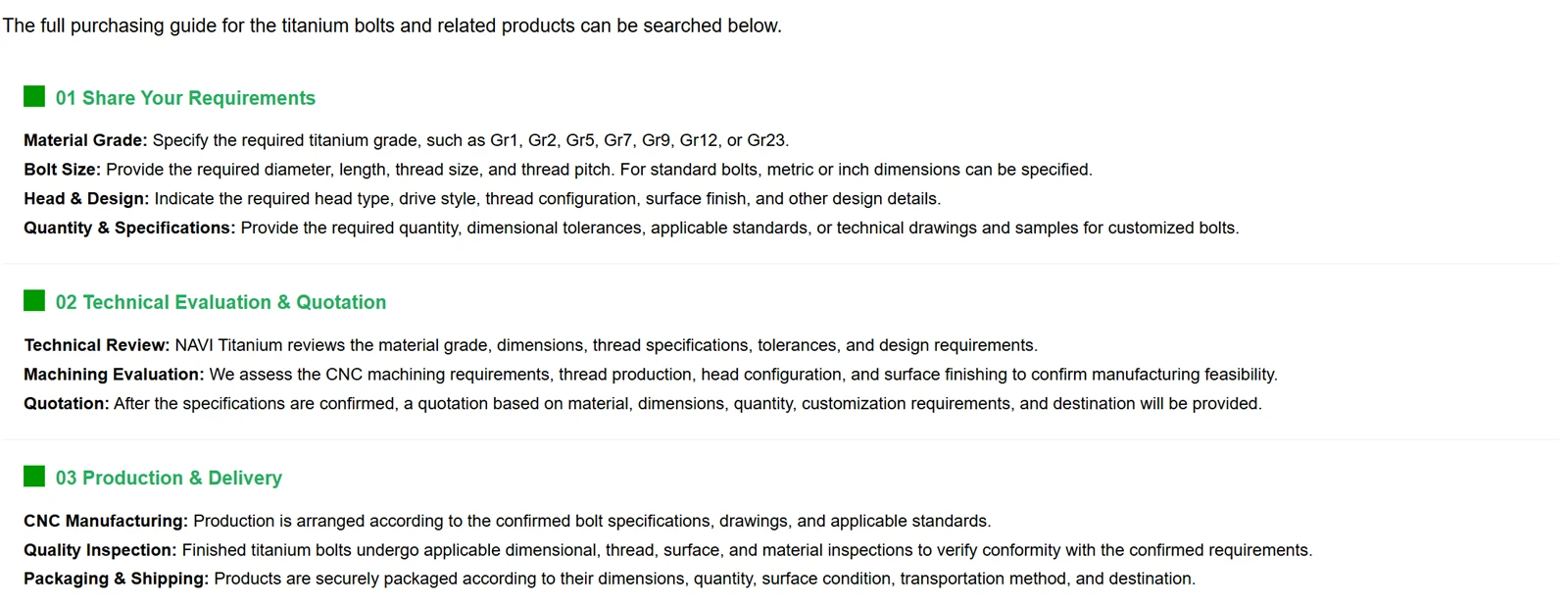
Purchasing guide
Quality control (QC)
For Ti-alloy fastening components intended for ultra bee suspension mounts, foot controls, handlebar assemblies, and accessory interfaces, material traceability is closely related to the reliability of the final mechanical connection. NAVI Titanium maintains supporting quality documentation.

Titanium Bolts Manufacturing Process
Ti Grade Selection
High-performance Ti alloy stock, such as Grade 5 (Ti-6Al-4V), is selected according to mechanical strength, corrosion resistance, and intended motorcycle mounting applications. Incoming stock is evaluated for surface integrity and compliance with specified composition requirements.
01
Precision CNC Machining
Computer numerical control machining produces the required bolt geometry, including head profiles, shank dimensions, and threaded sections. Cutting parameters and tooling are coordinated to minimize machining defects and maintain dimensional accuracy across different fastening configurations.
02
Thread Cutting and Surface Finishing
Precision thread rolling or cutting establishes the specified pitch, engagement length, and profile. Subsequent deburring, polishing, and optional anodizing treatments improve surface uniformity, edge quality, and corrosion resistance while accommodating the required appearance.
03
Dimensional Verification
Thread gauges, calibrated measuring instruments, and mechanical testing procedures are used to assess tensile properties, and fastening requirements. Completed fastening components are separated by specification, securely packaged, and labeled to facilitate inventory management and prevent surface damage during international transportation.
04
Packaging and Shipping Protection
Packaging precision is particularly important for NAVI Titanium Ti-alloy fastening hardware supplied for motorcycle suspension assemblies, footpeg brackets, handlebar mounts, and accessory installations. Before packing, fastening components are grouped according to thread pitch, nominal diameter, overall length, head configuration, and surface treatment to prevent specification confusion during subsequent assembly. Individual protective bags, compartmentalized trays, or soft separators can reduce metal-to-metal contact, thread abrasion, and cosmetic damage, especially for polished or anodized finishes. Moisture-resistant inner packaging helps limit exposure to humidity and condensation during extended international transit. For mixed-specification orders, clearly printed labels, part numbers, quantity markings, and corresponding packing lists simplify warehouse identification and inventory reconciliation. Small hardware sets can also be arranged in dedicated compartments to facilitate aftermarket distribution and workshop installation. Proper separation and cushioning are particularly relevant to precision-machined threads and lightweight components, where careless handling may cause scratches, deformation, or cross-contamination between specifications.

Transportation Security and Shipment Management

For international wholesale orders, outer packaging should accommodate shipment volume, transportation duration, handling frequency, and the destination's storage conditions. Individually protected fastening components can be consolidated into labeled inner boxes before placement in reinforced corrugated export cartons. Appropriate cushioning materials, internal dividers, and secure carton sealing help minimize movement, impact, and compression during truck transportation, container loading, and repeated cargo transfers. For larger orders, palletized arrangements or reinforced wooden cases may be considered according to gross weight, shipment dimensions, and carrier requirements. Moisture barriers and suitable desiccants can provide additional protection against humidity fluctuations and condensation during ocean freight. Carton markings should identify specifications, quantities, gross weight, net weight, destination details, and handling instructions where applicable. Consistent carton numbering and packing-list references also facilitate customs documentation, warehouse receiving, and order reconciliation. Such coordination is valuable for international distributors handling multiple motorcycle models, replacement hardware kits, and recurring procurement schedules, helping reduce receiving errors and simplify downstream inventory management.
Application Areas
NAVI Titanium supplies surron ultra bee titanium bolts for frame, subframe, motor, footpeg, handlebar, brake, controller, fender, protective guard, and front and rear wheel applications, with precision machining, lightweight construction, and corrosion resistance for motorcycle assembly and modification.
Frame and Subframe Connections: Ti-alloy fastening hardware secure frame and subframe joints, where dimensional accuracy, appropriate clamping force, vibration resistance, and corrosion protection are important for long-term structural assembly.
Motor Mounting: Fastening components at motor mounting points require accurate thread engagement, suitable tensile strength, and controlled tightening to accommodate operational vibration and mechanical loads during repeated riding cycles.
Footpeg Brackets: Ti bolts installed on footpeg brackets are suited to weight-conscious motorcycle configurations, with attention to impact loading, joint alignment, thread durability, and reliable retention under off-road conditions.
Handlebar, Brake and Controller Assemblies: Cockpit fastening locations include handlebar clamps, brake components, and controller brackets, requiring precise dimensions, compatible thread specifications, and appropriate clamping procedures for dependable installation.
Fenders and Protective Guards: Fastening components for fenders, skid plates, and protective panels require suitable head profiles, corrosion resistance, and secure attachment to accommodate vibration, debris impact, and frequent maintenance.
Front and Rear Wheel Assemblies: Wheel-related fastening applications demand strict compliance with specified dimensions, strength grades, thread engagement, and torque requirements, with compatibility verified against the original mechanical design.
Head Geometry and Mechanical Interface
A titanium bolt manufacturer such as NAVI Titanium should address common configurations including internal hexagon, external hexagon, round head, countersunk/conical head, flange head, and torx head according to the accessibility, clamping interface, clearance, and assembly method of the motorcycle joint. Internal hexagon designs are useful where radial clearance around the fastening component is limited, while external hexagon heads suit conventional socket or wrench access. Round heads can reduce exposed edges on selected mounting locations, whereas conical heads allow a more integrated seating arrangement when the mating component is correspondingly countersunk. Flange heads enlarge the bearing area beneath the head, potentially reducing localized contact pressure and eliminating a separate washer in suitable applications. Torx profiles distribute driving forces across multiple contact surfaces and can reduce driver cam-out during controlled assembly. For titanium fastening hardware, head geometry should be considered together with thread engagement, friction behavior, tightening torque, tool compatibility, and mating-component design rather than selected solely for appearance.
| Head configuration | Typical engineering consideration |
| Internal Hex | Restricted access and compact installation zones |
| External Hex |
|
| Round Head | Reduced exposed profile and smooth external contour |
| Conical Head |
|
| Flange Head | Increased bearing area and load distribution |
| Torx Head | Positive tool engagement and controlled tightening |
FAQ
1. Which head configuration should be selected for motorcycle fastening components?
-
The choice depends on available tool clearance, mating-component geometry, required bearing area, and accessibility during maintenance. Internal hex, external hex, Torx, flange, round, and conical heads serve different installation conditions.
2. Are conical-head fastening components suitable for all motorcycle mounting points?
-
No. A conical head should be paired with a correctly machined countersunk interface.
3. When is a flange-head design useful?
-
A flange head can increase the contact area beneath the head, helping distribute clamping pressure across the joint.
4. How should titanium fastening hardware be tightened during installation?
-
Installation should follow the specified torque for the particular joint rather than relying on a generic torque value.
5. Can different head styles be combined in one motorcycle hardware kit?
-
Yes, when each fastening position has been technically evaluated. Mixed configurations can accommodate different access conditions, clearance limitations, and component geometries while allowing workshops or distributors to organize hardware according to specific installation locations.
Hot Tags: surron ultra bee titanium bolts, China surron ultra bee titanium bolts manufacturers, suppliers, factory