


NAVI Titanium makes MMO anodes by bonding a tailored ceramic film to a Ti body that carries the power flow instead of being consumed by it - Ru, Ir, or a formulation selected for one process. The finish is the working face; the base conducts. Buyers come for three things that show up in accounts: a cell voltage holding the value it was commissioned at, a wear rate quoted before the order, and a base stripped and re-finished rather than scrapped.
Solution of NAVI Titanium
Specify an electrode backwards: name the process first, then the finish, then the shape. Chlor-alkali duty, oxygen-generation duty and hypochlorite service ask for different noble-metal formulations, and the wrong one burns out in months however heavily it is applied. Brine purity, temperature, amperage density and reverse-flow events during shutdown matter equally, since they decide whether the film wears evenly or lifts. Answer those four in writing first and the recommendation becomes simple arithmetic rather than a guess. The systems we hold, with the duty each is formulated for, sit in the NAVI Advanced DSA Ti Electrode table below.


Forms follow the cell, not a catalogue: flat plate, sheet cut to a tank wall, tube and rod for cells, expanded and woven lattice panels, strip and ribbon for channels, discs and rings for housings. Holes, tabs and edges go in before finishing, never after. Send a STEP or DWG file - outline, holes and weld details are quoted as drawn.


Application
Two duties take most of the NAVI Titanium MMO anodes we ship, and both charge for the wrong finish in the same currency: power and downtime. One runs hot brine at high amperage, the other sits in sulphate with O₂ coming off the face. Neither forgives a film formulated for the other process. Both get quoted against a campaign, not catalogue service span.
Chlor-Alkali and Chlorate Cells
Membrane and diaphragm cells, and the chlorate cells fed from the same brine, take the largest share of what we supply. The duty looks simple - generate Cl₂ at a few kiloamps per square metre - but three details decide how long the film lasts.
Brine carrying hardness salts or sulphate scales the face and pushes voltage up; a cell drained hot while power is still on drives reverse flow back through the finish; and unplanned stop-starts spend a little more of the active area.
NAVI pair the formulation to the cell type and quote the dose in grams per unit area, so the wear figure on the quotation is the one the campaign is judged against. Plants that send brine analysis, amperage density and shutdown practice in writing get a priced drawing and an expected campaign; plants that send only a part number get a catalogue reply, rarely the cheaper one.

Electrowinning and Metal Recovery
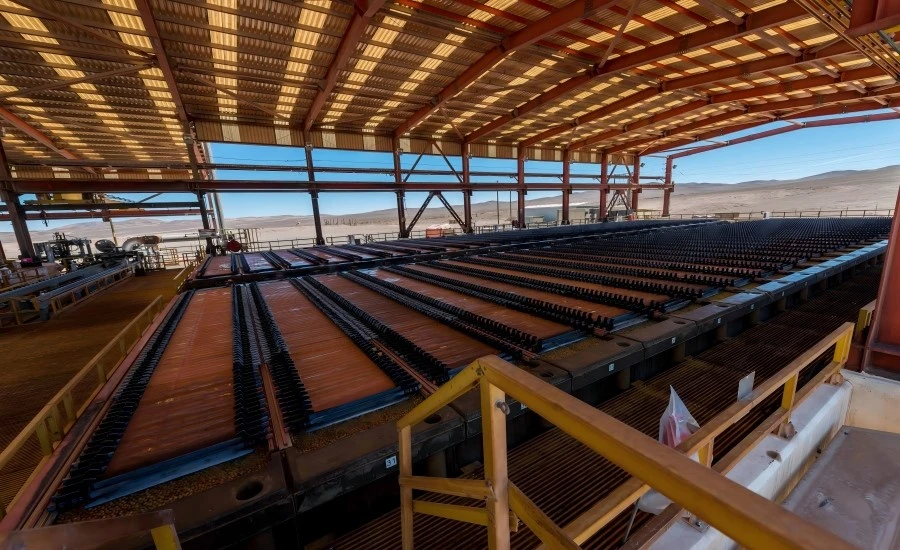
Copper, zinc, manganese and cobalt are won from sulphate liquor on electrodes that used to be lead. Moving to coated Ti changes three lines on the cost sheet at once: O₂ overvoltage falls, so the rectifier delivers the same tonnage for less power; lead stops entering the cathode, so metal meets specification without a cleaning step; and the sludge previously treated as hazardous waste is no longer produced.
Re-gapping work ends, shorting from lead creep disappears, and the whole bank holds its geometry from campaign to campaign. The trade is honesty about the liquor - fluoride, manganese dioxide build-up and strong acid at raised temperature all shorten finish service span, and a formulation mixed for Cl₂ generation will not survive a hard O₂ duty.
Send the liquor analysis and the cell voltage you run today, and NAVI will say plainly whether the change pays back within the expected period or not at all.
Purchasing guide

Quality control(QC)
Each order leaves NAVI Titanium ISO 9001 works carrying a document number that ties the Ti mill sheet, finish weight, bond result and lifespan-rig hours to that single batch. We would rather you check the file than take the claim: press the button below to open our COA in full and read the figures for the batch being built for you.
| Certificate of Analysis | ||
| Titanium Base Material Suppliers: | Coating Precursor Suppliers: | COA of product: |
|
|
|
|


Manufacturing Process
Every NAVI Titanium MMO anode is produced through a strictly regulated heat-based decomposition process. From Ti base preparation to final electrolytic verification, each step is monitored to build a stable, high-bond blended alloy ceramic finish that delivers long lifespan and consistent output.
| Step | Process | Key Control Point |
|---|---|---|
| 1 | Titanium Substrate Preparation | Material grade (Gr1/Gr2), cutting & forming accuracy |
| 2 | Degreasing & Surface Etching | Etching uniformity for coating adhesion |
| 3 | Coating Solution Preparation | Precise metal-salt composition & purity |
| 4 | Coating Application | Uniform layer thickness (brush/dip/spray) |
| 5 | Drying | Controlled low-temperature solvent removal |
| 6 | Thermal Decomposition (Sintering) | Temperature & time profile (300–550°C) |
| 7 | Repeat Coating Cycles | Layer count & oxide loading control |
| 8 | Final Inspection & QC | Adhesion, uniformity, lifetime testing |
Different Anode Material Comparison
NAVI Titanium DSA electrodes are produced through a regulated heat-based decomposition process: Ti base machining, acid etching, repeated application of blended Ir/tantalum ceramic finish and high-temperature firing. The comparison table below shows how electrodes perform against other common electrode materials in key parameters. Actual values vary with operating conditions and application; the data is for general reference only.
| Parameter | MMO Anode (Ti/IrO₂-Ta₂O₅) | Graphite Anode | Lead Dioxide (PbO₂) Anode | Platinum-Coated Anode |
|---|---|---|---|---|
| Working Current Density | High (100–2000 A/m², higher in chlorine service) | Low (50–500 A/m²) | Medium (500–1000 A/m²) | High |
| Oxygen Evolution Overpotential | Low (approx. 0.3–0.5 V) | High | High | Low |
| Consumption / Service Life | Negligible dimensional loss; long life (commonly 3–10+ years by loading) | High consumption (approx. 0.5–1.5 kg per tonne); frequent replacement | Gradual dissolution; medium life | Coating wear possible; life depends on density |
| Dimensional Stability | Excellent (dimensionally stable) | Poor - keeps thinning | Fair | Good |
| Environmental Impact | No heavy-metal pollution | No heavy metals, but high maintenance | Lead pollution risk | High precious-metal cost |
| Typical Applications | Electrowinning, cathodic protection, electrochlorination, water treatment, electroplating | Historical chlorine/chlorate electrolysis | Zinc / manganese electrolysis | Special electrolysis, precious-metal recovery |
NAVI Titanium - Quality You Can Trust, Partnership That Lasts
NAVI Titanium is a specialized manufacturer of high-performance MMO anodes and Ti electrolytic products. Our modern factory is fully dedicated to electrode production and continuous improvement. From raw Ti base to finished treated electrode, every stage is regulated in-house, which guarantees consistent quality, stable shipment and competitive pricing. Our production team follows strict standard operating procedures, and every batch is assigned a unique traceability code that records material class, finish composition and process parameters.
We understand that an electrode failure can stop an entire production line, so reliability is built into every film of the finish. Years of practical experience across electrowinning, negative-electrode shielding, electroplating and water processing allow us to offer proven solutions instead of experimental products. Our engineers help you choose the right electrode configuration for each condition. We combine industrial expertise with responsive communication, giving every customer a single accountable partner from first inquiry to final shipment.


Quality is the foundation of customer trust. NAVI Titanium sources Class 1 and Class 2 Ti bases with verified purity and selects high-purity Ir and tantalum compounds for the blended alloy ceramic finish. Every electrode passes a complete check routine on every item before leaving the factory, including finish bonding verification, accelerated electrolytic lifespan verification, dimensional verification and visual face check. Finish uniformity and heat-based decomposition parameters are monitored continuously during production, and each batch keeps complete records for full traceability.
Our in-house laboratory runs regular electrolytic output checks, so promised service span and amperage efficiency are supported by measured data rather than simple claims, backed by full test records. If any quality concern appears after shipment, our technical team responds quickly with root cause analysis and a practical solution. We believe long-term cooperation is built on consistent, verifiable quality, and that is exactly what we deliver with every order.
Beyond excellent products, NAVI Titanium is committed to making every cooperation smooth and worry-free. We offer OEM and customized MMO anode designs according to your working conditions, amperage density and electrolyte composition, with free technical consultation before purchase. Our engineers study your working conditions carefully. Sample orders are welcome so that customers can verify output at minimal risk.
Our packing is designed for long-distance sea and air freight, and our logistics team ensures on-time shipment with complete documentation. After shipment, we provide installation guidance, operating recommendations and responsive after-sales support, and a dedicated contact person stays with your project from inquiry to reorder.
We keep regular contact and check electrode output. We communicate honestly about specifications, lead times and limitations, because transparency is the fastest way to build trust. Many customers continue ordering from us year after year, and we invite you to become the next long-term partner of NAVI Titanium.

FAQ
1. How does a custom order run, and what happens if a batch is wrong?
-
Send liquor analysis, temperature, current density, duty cycle and a drawing - a dimensioned proposal follows within [[CONFIRM: days]], and samples can be coated on the same line as production. Minimum quantity and lead time depend on geometry and are stated per order. If a batch misses the agreed loading or bond figure, we remake it and carry the freight; warranty excludes dry running, reverse current and mechanical damage.
2. What do buyers in different markets ask us for?
+
-
European buyers ask for EN 10204 3.1 with REACH and RoHS statements. North American buyers reference ASTM B265 or B338 for the substrate and want coating data tied to a lot. Japanese buyers ask for JIS H4600 and often audit before ordering. Middle Eastern buyers ask about high ambient temperature and saline make-up water. South East Asian buyers ask about lead time and packing for humid transit.
3. What damages a coated anode, and what routine care does it need?
+
-
Four things shorten life more than normal wear: running dry, reverse current during shutdown, fluoride in the liquor, and organic or cyanide contamination. Fit interlocks that cut current before the level drops and that block reverse current on stop. Never scrape with steel; do not pickle in inhibited hydrochloric acid; store spares dry and packed flat.
4. How do I know when an anode has reached end of life?
-
Three signals, in order of reliability: cell voltage at constant current has climbed beyond [[CONFIRM: %]] above commissioning, the surface shows bare titanium or heavy flaking, or a returned sample is measured for remaining noble metal. Rising voltage is the one operators notice first, so log it monthly. If the substrate is sound and undeformed, stripping and re-coating usually costs less than new.
5. Why does the same MMO anode last years in a chlor-alkali cell but under a year in my oxygen-duty tank?
+
-
Because the coating is mixed for a reaction, not for a shape. Blends rich in ruthenium are excellent at chlorine evolution and poor at oxygen evolution; iridium-based systems are the reverse, at higher cost. Run the wrong one and the layer consumes itself regardless of thickness. Tell us the reaction, the liquor and the current density and the recommendation follows from those three.
Hot Tags: mmo anode, China mmo anode manufacturers, suppliers, factory, basket titanium electrode, custom coated titanium anode, dimensionally stable titanium electrode, electrolytic coated titanium anode, titanium anode for electrochemical treatment, titanium anode for organic electrosynthesis


