

Swimming pools need constant and dependable water treatment. If you own a public swimming facility or a private saltwater pool, the effectiveness of your disinfection system significantly impacts the safety of your swimsuits and your running expenses. A subtle ingredient in pool sanitation today is the titanium anode rod, a high-performance electrode that provides on-site chlorine production without the risk of storing bulk chemicals.
In this article, we cover the role of titanium anode rods in pool electrolysis systems, why they are better than traditional electrode materials, and what to look for when choosing one for your particular application.
How Does a Titanium Anode Rod Support Saltwater Pool Disinfection?
Saltwater pools don't reduce chlorine, they manufacture it on site using electrolysis. When a dilute solution of sodium chloride is passed through an electrolytic cell, an electric current divides the salt molecules. The anode side of the reaction creates chlorine gas that instantly dissolves into the water as hypochlorous acid (HOCl), the active disinfectant.
The titanium anode rod is the focus of this technique. It conducts the anodic current of the chlorine evolution reaction (ClER). The reaction takes place in a strongly oxidizing, salt-saturated atmosphere; so the electrode material must be resistant to harsh chemical assault and provide a consistent electrochemical output for thousands of hours of operation.
Why Titanium Is the Baseline Material?
Industrial pure titanium (Grade 1 TA1 or Grade 2 TA2) is a suitable substrate for pool electrolysis electrodes. Titanium develops a passive oxide film in natural surroundings, which prevents corrosion of the metal in chlorinated brine. However, same passivation action, when titanium is bare, also results in increased electrical resistance over time. And that's why the surface is coated with a catalytic coating.
The substrate is produced from high quality titanium and coated with a precious metal oxide layer, often a ruthenium-iridium (Ru-Ir) or iridium-tantalum (IrO₂-Ta₂O₅) formulation at NAVI Titanium. The coating thickness is normally from 2 to 15 microns.

The thickness is small enough to be cost effective and dense enough to provide steady activity for chlorine evolution across a broad range of current density, 10-50A/m2 and up to 2000-5000 A/m2 .
The Electrochemical Reaction at the Anode Surface
The oxidation of chloride ions (Cl⁻) at the anode surface proceeds as follows: 2Cl⁻ → Cl₂ + 2e⁻ The dissolved chlorine then combines with water to generate hypochlorous acid and hypochlorite ions – both powerful disinfectants. The construction of these rods is called a mmo anode ( mixed metal oxide anode ) . This reduces the overpotential for this reaction , meaning less energy is lost making heat and more is utilized for productive chlorine generation . The measured cell resistance may be as low as < 0.02 Ω. This immediately translates into decreased power expenses over the lifespan of the pool.
Titanium Anode Rods for On-Site Chlorine Generation in Swimming Pools
The on-site manufacture of sodium hypochlorite is growing rapidly in the municipal pool, water park and hotel water park markets. Instead of buying, hauling and storing liquid chlorine or chlorine gas, which have regulatory and safety constraints, operators run a saline feed solution through an electrolyzer and pump the resultant hypochlorite straight into the pool circuit.
Scale and Capacity Considerations
Pool electrolysis systems vary from tiny machines making 50g/h of available chlorine for small residential pools to industrial size generators making 5,000g/h or more for major public facilities. The specified titanium anode rod should be suitable for the necessary current load and production capacity. NAVI Titanium's ruthenium-iridium titanium anodes are designed to span this whole range of operation, accommodating projects from 50 g/h to 5,000 g/h of possible chlorine production without sacrificing electrode stability.
Why Graphite, Stainless Steel, and Lead Cannot Replace Titanium?
Graphite anodes are easily attacked in chlorinated electrolytes, generating carbon particles that pollute the water. Stainless steel anodes are passivated during anodic polarization but might be susceptible to pitting corrosion by chloride ions. Lead dioxide anodes have been employed historically in certain industrial electrochemical processes, but they pose concerns of heavy metal contamination that are not acceptable in recreational water.
In saline conditions iron and copper are anodic, are dissolved and discolor surfaces in the pool and alter water chemistry.
A titanium mixed metal oxide coating removes all these failure mechanisms. The substrate does not change dimensions, the coating retains its catalytic activity and there are no releases of hazardous by-products into the water stream. It is this combination that has led to mmo anode technology being the dominant electrode architecture in the chlor-alkali and water treatment sectors, with adoption rates of over 70% for chlor-alkali alone.
How Titanium Anode Rod Chlorine Evolution Supports Continuous Water Disinfection
Pools are not disinfected in a batch operation. The bathers are still depositing organic matter load, which demands a real time response by the disinfection system. Therefore, the chlorine evolution reaction on the surface of the titanium anode rod should maintain a stable output under the condition of continuous operation for 24 h without the decrease of electrochemical performance.
Gradient Coating Technology and Coating Adhesion
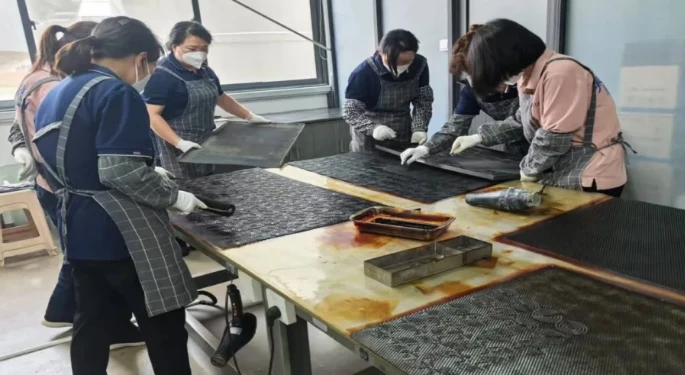
A long-standing problem in electrode production is the delamination of the coating, i.e., the separation of the precious metal oxide layer on the microscale from the titanium substrate. Delamination is accelerated by both heat cycling and mechanical stress , resulting in premature loss of performance . NAVI Titanium solves this problem with multi-layer gradient stress-relief coating technique where the composition progressively changes from the substrate interface to the outer catalytic surface. The internal stress is distributed across many layers instead of being concentrated at a single contact, thereby minimizing the production of microcracks and the penetration of chloride ions into the substrate.
Substrate Passivation Prevention
The main reason for the unexpected voltage spike and capacity loss of pool electrolysis cells is substrate passivation, which is the undesirable formation of a non-conductive TiO2 layer at the interface between the metal and the coating. NAVI Titanium uses an advanced pretreatment method that alters the titanium surface at the microstructural level prior to coating application, enhancing the mechanical interlocking and electrochemical bonding between the substrate and the mixed metal oxide layer. The outcome is a stable electrode that will keep its output profile for a service life of 8 to 10 years under regulated operation settings.
Titanium Anode Rod Selection for Different Pool Electrolysis Conditions
Not every pool operates under the same conditions. Salinity, water temperature, current density, and chlorine demand all vary by application type, and the electrode must be matched to these parameters to deliver reliable service.
Coating Chemistry Selection
Ruthenium-iridium coatings show excellent chlorine evolution selectivity, i.e. the bulk of the anodic current is used for Cl 2 synthesis and not for the competing oxygen evolution process. IrO2-Ta2O5 coatings provide an alternative trade-off with a longer lifetime in low salinity or variable-current applications. Platinum coatings are suitable for specialized applications where extremely high purity and resistance to organic fouling are needed. NAVI Titanium has all three formulas, plus special coating chemistry created in conjunction with the operator's processing conditions.
Rod Geometry and Surface Area
The active surface area for the electrolysis is determined by the geometrical shape of the electrode, i.e. cylindrical rod, flat plate, expanded mesh or tubular arrangement.
A larger surface area means less current density locally, which means longer coating life and better chlorine production efficiency. For pool systems with set electrolytic cell geometry, NAVI Titanium can produce rods to customer's design drawings in specific dimensions for perfect fit and electrical performance.
What Makes a Titanium Anode Rod Suitable for Long-Term Pool Disinfection?
Longevity in pool electrolysis service depends on three interacting factors: substrate quality, coating integrity, and operational compatibility. A rod that excels in all three delivers the low total cost of ownership that pool operators seek.

Energy Efficiency and Operating Cost
Unit energy consumption is one of the most important criteria in continuous pool disinfection. NAVI Titanium's interface catalysis optimization technology decreases cell voltage, boosts chlorine evolution activity and preserves production capacity for the whole service life of the electrode. This corresponds to a specific energy consumption of 3.2–3.8 kWh kg−1 of accessible chlorine, which lowers the operational expenses of the system by 10–25% compared to standard electrode designs. The large energy savings make the initial investment in a quality titanium anode rod quite attractive over a multi-year operating cycle.
Service Life and Maintenance Impact
Frequent electrode replacement is one of the largest hidden costs in pool water treatment. Each replacement involves downtime, labor, and the procurement of new components.
A titanium anode rod with a verified service life of 8–10 years under controlled conditions reduces replacement frequency significantly, amortizing the full-cycle cost across a longer operational horizon. NAVI Titanium's rods undergo rigorous electrochemical performance verification before shipment, providing customers with confidence in their long-term reliability.
Conclusion
The titanium anode rod is the heart of any on-site chlorine production system for swimming pool disinfection. Only this electrode can withstand the chlorine evolution reaction in corrosive, high-salinity electrolytes without polluting the water or deteriorating quickly, making it the only feasible long-term option. The performance and lifetime of the disinfection system is determined by the choice of the correct coating chemistry, substrate quality and geometric arrangement of the rod for the particular circumstances of your pool.
FAQ
Q1: Can a titanium anode rod be used in both residential saltwater pools and large commercial aquatic facilities?
+
-
Yes. Titanium anode rods are scalable across pool sizes. NAVI Titanium manufactures electrodes suitable for systems producing 50 g/h up to 5,000 g/h of available chlorine, covering residential, hotel, water park, and municipal pool applications.
Q2: How long does a titanium anode rod typically last in a pool electrolysis system?
+
-
Under controlled operating conditions - appropriate current density, consistent salinity, and proper maintenance - a high-quality titanium anode rod with a mixed metal oxide coating achieves a service life of 8–10 years. Overloading the current density or allowing the electrolyte concentration to fall outside the designed range can shorten this lifespan.
Q3: What is the difference between a ruthenium-iridium coating and an IrO₂-Ta₂O₅ coating for pool anodes?
+
-
Ruthenium-iridium coatings prioritize chlorine evolution selectivity, making them highly efficient in standard saline pool electrolysis conditions. IrO₂-Ta₂O₅ coatings offer greater durability under variable current loads and lower chloride concentrations. The optimal choice depends on the specific operating parameters of the pool's electrolysis system. NAVI Titanium provides consultation to help customers identify the appropriate coating for their application.
Partner With NAVI Titanium for Your Pool Disinfection Electrode Needs
NAVI Titanium has been engineering precision electrochemical components since 2008, serving pool disinfection, wastewater treatment, PEM systems, and chlor-alkali industries worldwide. As a dedicated titanium anode rod supplier, NAVI Titanium delivers ruthenium-iridium and IrO₂-Ta₂O₅ coated anodes built for continuous, high-demand chlorine generation. Every rod benefits from advanced gradient coating technology, refined substrate pretreatment, and rigorous quality verification - giving your pool system the reliability it needs for 8–10 years of low-maintenance operation. Custom specifications, free samples for standard configurations, and one-on-one technical support are available.
Reach out to NAVI Titanium's engineering team at sales@navititanium.com to discuss your pool electrolysis requirements and receive a tailored product recommendation.
References
1. Trasatti, S. (1987). Electrocatalysis in the anodic evolution of oxygen and chlorine. Electrochimica Acta, 32(3), 369–382.
2. Karlsson, R. K. B., & Cornell, A. (2016). Selectivity between oxygen and chlorine evolution in the chlor-alkali and chlorate processes. Chemical Reviews, 116(5), 2982–3028.
3. Comninellis, C., & Vercesi, G. P. (1991). Characterization of DSA-type oxygen evolving electrodes: choice of a coating. Journal of Applied Electrochemistry, 21(4), 335–345.
4. Martínez-Huitle, C. A., & Ferro, S. (2006). Electrochemical oxidation of organic pollutants for wastewater treatment: direct and indirect processes. Chemical Society Reviews, 35(12), 1324–1340.
5. Zeradjanin, A. R., Menzel, N., Schuhmann, W., & Strasser, P. (2012). On the faradaic selectivity and the role of surface inhomogeneity during the chlorine evolution reaction on ternary Ti–Ru–Ir mixed metal oxide electrocatalysts. Physical Chemistry Chemical Physics, 16(27), 13741–13747.
6. World Health Organization. (2006). Guidelines for Safe Recreational Water Environments, Volume 2: Swimming Pools and Similar Environments. WHO Press, Geneva.



