


Compressed air is widely used in industrial automation, pneumatic control systems, instrumentation, and process equipment. Although compressed air may appear clean, it can contain dust, metal particles, oil aerosols, moisture, and contaminants introduced through compressors or pipelines. When these contaminants enter precision valves, regulators, flow-control components, or narrow internal passages, they may interfere with component movement and affect equipment reliability.
As a manufacturer of porous metal filtration components, NAVI Titanium develops customized sintered bronze filters for applications where compact filtration, stable airflow, and equipment protection are required. This engineering case illustrates how a porous bronze filter can be integrated into a pneumatic component to control particulate contamination while maintaining the required flow path. The solution is particularly suitable for OEM components where installation space is limited and a conventional external filter assembly is not practical.
Engineering Challenge
The application requires a compact filter to be installed upstream of a precision pneumatic component. The equipment operates continuously, while the available installation space around the inlet connection is restricted.
The engineering requirements include:
- Effective removal of solid particles;
- Stable airflow; Controlled pressure drop;
- Adequate mechanical strength; Compatibility with compressed air;
- Consistent filtration performance; Compact and customizable geometry.
The challenge is therefore not simply to select a specific micron rating. The filter needs to balance filtration efficiency, flow capacity, pressure drop, mechanical stability, and installation requirements.
For this type of application, NAVI Titanium evaluates the filter as part of the complete pneumatic system rather than treating it as an independent replacement component.
Why Sintered Bronze?
Manufacturing process
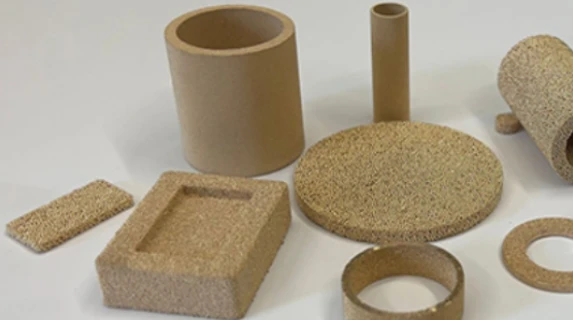
Sintered bronze filters are manufactured by compacting bronze powder into a specified shape and sintering the compact under controlled conditions. During sintering, powder particles bond together, with interconnected pores reserved inside the metallic structure.
Filtration mechanism
These pores form three-dimensional flow paths throughout the filter. When compressed air flows through the porous material, solid contaminants are captured within the structure, while air passes through the connected pore channels.
Key feature vs. surface screens
Unlike simple surface screens that only trap contaminants on the outer layer, it provides depth filtration. Particles are captured inside the porous medium, while maintaining the structural advantages of metallic filters.
Advantages for industrial gas/air filtration
For general industrial air and gas filtration, sintered bronze features a desirable combination of filtration performance, mechanical stability, production flexibility and cost-effectiveness.
Reference Engineering Design
The following parameters represent a typical engineering framework for evaluating a sintered bronze filter for pneumatic equipment. They are reference values rather than fixed specifications.
|
Parameter |
Reference Design |
|
Material |
Sintered Cu-Sn Bronze |
|
Filtration Rating |
5–80 μm, application dependent |
|
Medium |
Compressed air / gas |
|
Filter Form |
Tube / Disc / Cup / Plug |
|
Structure |
Interconnected porous metal |
|
Installation |
Press-fit / Threaded / Customized |
|
Main Function |
Particle filtration & equipment protection |
NAVI Titanium can adjust the material structure, filter dimensions, and geometry according to the actual application. The final design should be determined using the required flow rate, working pressure, temperature, pressure drop, and contaminant characteristics.
Balancing Filtration and Flow
Common misconception in filter selection A frequent mistake when choosing filters is only pursuing the smallest filtration rating.
Trade-off of finer pore structure Finer pores help capture more particles, yet they raise airflow resistance. Insufficient filter area will cause excessive pressure drop, disturbing downstream pressure and the operation of pneumatic equipment.
Core engineering balance The design goal is to strike a proper balance among four key parameters: Filtration Rating + Flow Rate + Pressure Drop + Filter Area
Preferred design approach for compact pneumatic parts For compact pneumatic components, expanding filter area often works better than simply adopting a finer pore structure.
NAVI Titanium support NAVI Titanium assesses all these factors in product development, to define the suitable porous structure and filter geometry matching your working conditions.
Protecting Precision Components
The main function of the filter in this application is to prevent particulate contamination from reaching sensitive downstream components. Small particles can accumulate in narrow passages or interfere with moving components. In precision valves and regulators, contamination may affect valve movement, flow stability, sealing surfaces, or control response. A properly designed sintered bronze filter can therefore act as a protective barrier between incoming compressed air and internal components. Typical protected components include:
| Pneumatic valves | Pressure regulators |
| Flow-control valves | Solenoid valves |
| Instrumentation components | Pneumatic actuators |
| Small gas passages | Industrial connectors |
The filter can be installed at the inlet, inside a connector, or directly within the equipment housing according to the customer's design.
Customized Filter Geometry
One of the advantages of sintered metal filtration is its flexibility in component geometry. Standard filter cartridges are not always suitable for compact OEM equipment. A customer may require a small cylindrical element, thin disc, cup-shaped filter, or customized plug that fits directly into an existing housing. NAVI Titanium provides customized porous metal components based on customer drawings, samples, or dimensional requirements.
|
Custom Feature |
Available Solution |
|
Geometry |
Disc / Tube / Cup / Plug / Custom |
|
Diameter |
Customized |
|
Length / Thickness |
Customized |
|
ID / OD |
Customized |
|
Filtration Rating |
Application-specific |
|
Porous Structure |
Application-specific |
|
Installation |
Press-fit / Threaded / Integrated |
This approach allows the filter to be designed around the equipment instead of forcing the equipment to accommodate a standard filter.
Quality Control
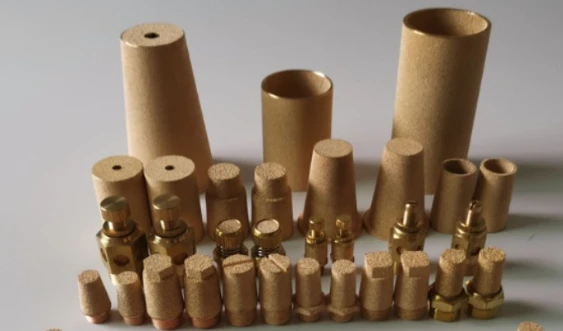
For porous metal filters, dimensional inspection alone does not fully represent product quality. The porous structure must also remain consistent throughout production because changes in density, pore characteristics, or processing conditions can influence filtration performance.
At NAVI Titanium, quality control can cover raw material inspection, dimensional inspection, visual inspection, porosity or permeability evaluation, filtration-related testing, and pressure-related inspection, according to the product and application.
Critical dimensions such as outer diameter, inner diameter, thickness, and overall length can be controlled according to customer drawings.
For batch production, controlling the powder preparation, compaction, and sintering processes is particularly important for maintaining consistent porous characteristics between production batches.
Conclusion
A sintered bronze filter is more than a simple porous component. When properly designed, it can combine particle filtration, equipment protection, controlled airflow, mechanical stability, and compact integration within a single metallic element. For pneumatic applications, successful filter selection requires more than specifying a micron rating. Flow rate, pressure drop, filtration area, working pressure, temperature, and contaminant characteristics must be evaluated together.
With its experience in porous metal component manufacturing, NAVI Titanium provides customized sintered bronze filters for OEM and industrial applications based on drawings, samples, dimensions, and actual operating requirements. For a technical evaluation, customers can provide the filter drawing or sample together with the required filtration rating, medium, flow rate, pressure, temperature, and quantity.



