


A continuing problem for water treatment plants is to provide dependable disinfection performance at reasonable operating and maintenance costs. Year after year, silently, electrode replacement, higher utility costs and unscheduled downtime eat away at budgets. The titanium anode rod solves each of these pain issues head-on, not with marketing fluff, but with quantifiable electrochemical engineering.
In this article we will explore the basic mechanisms behind energy reduction, coating accuracy, substrate modification and service-life extension, in an effort to help procurement engineers and plant operators understand why a titanium anode rod has become the standard choice for sodium hypochlorite generation, wastewater electrolysis and swimming pool disinfection around the world.
How Does a Titanium Anode Rod Reduce Energy Use in Water Treatment Electrolysis?
The Relationship Between Electrode Resistance and Power Consumption
All electrolytic water treatment systems incur an energy tax that is mostly a function of cell voltage. When the anode material has a high internal resistance or a passive oxide layer, the voltage supplied has to be higher to be able to force the same current through the system and this extra power is squandered as heat, not useful chemistry.
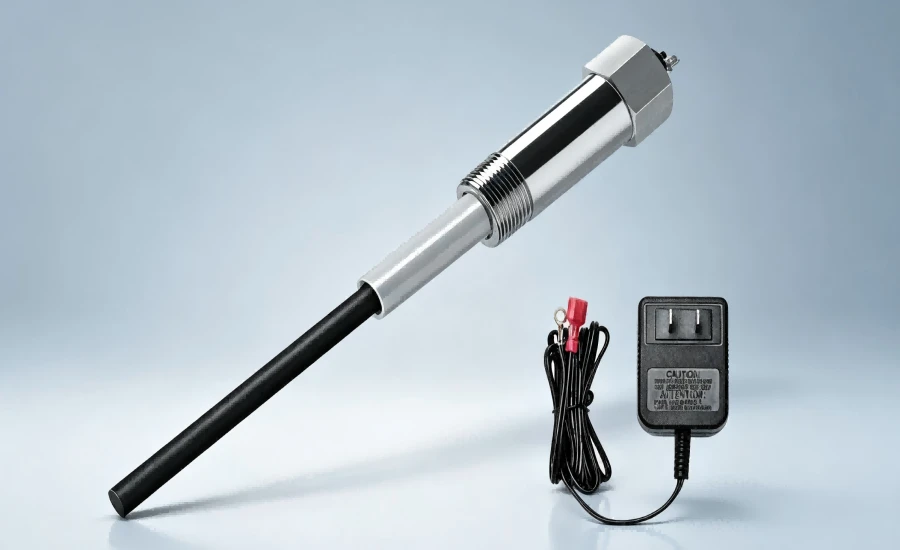
Titanium anode rod coated with mixed metal oxide (MMO) has cell resistance as low as < 0.02 Ω. Pure titanium alone is only moderately conductive, but the coating of precious-metal oxide makes the surface a highly catalytic low-resistance interface. The practical outcome is that sodium hypochlorite generators using MMO coated titanium rods often function at 3.2-3.8 kWh per kg accessible chlorine, a measure that cannot be matched by graphite, stainless steel and lead anodes under comparable operating circumstances.
Why Conventional Anode Materials Fall Short?
Graphite erodes slowly . This pollutes the electrolyte and reduces the active electrode surface over time , forcing operators to compensate with increased current . In chloride-rich situations stainless steel and iron quickly create passive layers which lead to unpredictable rise of cell voltage. Copper is soluble in oxidizing electrolytes and contributes to the metallic pollution of treated water. None of these materials can maintain a steady low-energy operating window for more than a few hundred hours of continuous operation.
In contrast, titanium generates a self-healing native oxide layer that preserves the substrate without hindering electron transmission at the coated surface. This physical stability is what, more than five decades ago, prompted the chlor-alkali industry to embrace titanium anodes, and now sees over 70% of the sector worldwide using them. The same stability is seen in water treatment facilities where 24-hour continuous electrolysis cycles are operated, with energy consumption savings reported at 20-40% compared to historical electrode materials, depending on the system design.
Titanium Anode Rods with Precise Precious-Metal Coating for Efficient Chlorine Evolution
Coating Composition and Chlorine Evolution Selectivity
Chlorine evolution process (ClER) is the electrochemical reaction to produce hypochlorite from brine. High ClER selectivity, i.e. preferred oxidation of chloride ions over water at the electrode, is essentially exclusively a function of the catalytic nature of the anode surface. Ruthenium dioxide (RuO 2 ) also has excellent ClER activity because to its d-band electronic structure, which may decrease the activation energy of Cl- adsorption and desorption. Iridium dioxide (IrO2) provides mechanical stability and resistance to electrochemical dissolution. Tantalum pentoxide (Ta2O5) is used as a structural binder which attaches the active oxides to the titanium substrate.
NAVI Titanium develops IrO2-Ta2O5 and Ru-Ir coating chemistries for electrolysis under high salt and severe oxidizing conditions. Coating thickness is 2 to 15 microns depending on the desired current density and estimated service life.


This accuracy is important because an under loaded coating wears down prematurely while an excessively thick coating might add internal tension that promotes delamination – both results enhance O&M expenditures needlessly.
Working Current Density Range and Operational Flexibility
One of the less widely recognized advantages of the titanium anode rod is its broad working current density window: 10-50 A/m2 for low intensity cathodic protection and water heater sterilization applications, rising to 2,000-5,000 A/m2 for industrial electrolytic metallurgy and high output sodium hypochlorite generation. This adaptability enables a single electrode product family to be used in municipal drinking water systems, industrial circulating water treatment, marine antifouling and PCB production lines without the need for completely distinct electrode chemistries.
How Substrate Modification Improves Titanium Anode Rod Electrochemical Performance?
Surface Pretreatment as a Foundation for Coating Adhesion
Any precious-metal oxide should be kept off the surface of the titanium, and the substrate should undergo thorough preparation. The residual machining fluids, the heterogeneities of the native titanium oxide and the changes of the surface micro-roughness all influence the adherence and the uniformity of the catalytic coating. Industrial grade pretreatment sequences combine acid etching (usually in oxalic or hydrofluoric acid baths) with controlled heat treatment to achieve a consistent micro-textured surface structure.
This micro-texture plays two purposes at once. It improves the electrochemically active surface area relative to the geometric area, which enhances the effective catalytic turnover without expanding the dimensions of the electrode. It also provides areas for mechanical interlocking that resist coating delamination under cyclic thermal and electrochemical stress.
Research groups have studied the modification of titanium substrates and have shown that an appropriate pretreatment may double or more than double the life of coating adhesion compared to untreated substrates under the same operating circumstances .
Passivation Resistance Through Modified Interface Engineering
A failure mechanism for long-running titanium anodes that has been well-documented is substrate passivation, which occurs when an insulating TiO 2 interlayer grows between the titanium metal and the catalytic coating. The thicker the interlayer, the higher the cell voltage and the lower the chlorine production. At some point, the electrodes need to be replaced, even if the outer coating still has some active material left. Interfacial resistance may be stabilized for long service durations by modifying the substrate interfaces using dopant incorporation or controlled thermal oxidation regimes that restrict interlayer development. This immediately minimizes unexpected replacement occurrences in continuous-duty water treatment applications.
Gradient-Coated Titanium Anode Rods for Longer Electrode Service Life
Why Single-Layer Coatings Accumulate Stress?
The coating is a uniform single-layer MMO coating, either pure ruthenium or a conventional ruthenium-iridium mix, applied as a chemically homogenous film across the thickness of the coating. During cyclic electrochemical loading shear stress is induced at the interface due to the mismatch in thermal expansion between the oxide covering and the titanium substrate. In the single-layer construction, this stress is focused at a single discrete interface, promoting microcrack nucleation and propagation.
Microcracks act as conduits for chloride ions to reach the titanium substrate directly and to start localized corrosion, which weakens the bond between the coating and the substrate from the bottom up. Delamination increases non-linearly after chloride penetration is initiated, which is a failure scenario that results in an electrode lifetime of 2–4 years under aggressive working circumstances.
Multi-Layer Gradient Architecture as the Engineering Solution
This failure mechanism is mitigated by gradient composite coatings which spread compositional shifts across a number of distinct layers. The innermost layers are optimized for maximal adhesion and passivation resistance, the intermediate layers are optimized for catalytic activity and mechanical compliance, and the outermost layer is optimized for ClER selectivity and dissolution resistance. Each compositional transition spreads stress across several interfaces rather than one.
The gradient coating method on NAVI Titanium is designed to provide an 8-10 year service life in sodium hypochlorite generator operation – a number that translates to a significant decrease in the annualized electrode replacement cost for any plant operating continuous 24-hour disinfection cycles. The embedded interface catalysis optimization in this architecture also sustains the chlorine evolution activity and the stable production capacity along the entire service period, with the unit energy consumption remaining in the 3.2–3.8 kWh/kg available chlorine range over the electrode life instead of progressively degrading.
How Does a Long-Life Titanium Anode Rod Reduce Electrode Replacement in Continuous Water Treatment?
Amortizing Capital Cost Across an Extended Service Period
The cost of replacing electrodes in a continuous water treatment plant is more than just the price of the new electrode. True replacement cost also includes maintenance work, system downtime, electrolyte flushing, recommissioning time, and lost disinfection capacity during changeover. If you double the life of an electrode from 2-3 years to 8-10 years then a facility that operates for 10 years will have 2-4 fewer replacement cycles.
For a 500 g/h sodium hypochlorite generator working continuously, the decrease in replacement frequency translates directly into a reduction in regular maintenance costs and unscheduled production disruptions. The total O&M savings for a fleet of generators in a municipal water treatment facility are considerable at the yearly budget level.
Stable Output Supporting 50–5000 g/h System Configurations
NAVI Titanium ruthenium-iridium titanium anode rods are for use in continuous operation across the whole capacity range for sodium hypochlorite generator projects from 50 g/h to 5,000 g/h. This category includes tiny swimming pool and drinking water disinfection systems to big municipal and industrial facilities. Stable electrochemical output across this range allows operators to maintain constant disinfection dosage without human correction for electrode deterioration, resulting in lower chemical overage costs and reduced danger of underdosing.
These rods have a mixed metal oxide (mmo) anode configuration that has been used for decades in chlor-alkali, wastewater treatment, semiconductor fabrication, and seawater desalination applications, providing procurement engineers with a reliable baseline of performance data for lifecycle cost modeling.
Conclusion
A titanium anode rod reduces water treatment O&M costs with four converging mechanisms: low electrochemical resistance to reduce energy consumption, precise precious-metal coating to maximize the selectivity of chlorine evolution, substrate modification to prevent passivation-driven failure, and gradient composite coating architecture to extend service life to 8-10 years. Each technique has a synergistic effect and produces a cumulative decrease in frequency of electrode replacement, energy expenses and unscheduled maintenance occurrences. The titanium anode rod provides a calculable and provable decrease in lifetime cost for any size facility using continuous electrolytic disinfection.
Frequently Asked Questions
Q1: What makes a titanium anode rod more energy-efficient than a graphite anode in sodium hypochlorite generation?
+
-
The titanium anode rod covered with mixed metal oxide keeps the cell resistance low (≤ 0.02 Ω) and the chlorine evolution selectivity steady throughout continuous working cycles. Graphite wears down over time, increasing the internal resistance and requiring more to be applied to maintain the output, increasing energy use per kilogram of accessible chlorine.
Q2: How long does a gradient-coated titanium anode rod last in continuous wastewater treatment service?
+
-
NAVI Titanium's gradient coated titanium anode rods have a service life of 8-10 years under regulated operating circumstances in sodium hypochlorite generator and continuous electrolysis applications. This is a good comparison to single layer coated electrodes, which normally have to be replaced every 2-4 years under similar working circumstances.
Q3: Can a titanium anode rod be customized for specific current density requirements?
+
-
Yes. NAVI Titanium manufactures titanium anode rods with a working current density range from 10-50 A/m2 to 2,000-5,000 A/m2, with coating chemistry, thickness and substrate geometry tailored to suit the specific electrochemical environment and operational requirements of each application, such as wastewater treatment, swimming pool disinfection and seawater antifouling.
Ready to Cut Your Water Treatment O&M Costs? Contact NAVI Titanium
NAVI Titanium has specialized in precision-engineered titanium anode rod products since 2008, operating from China's Baoji High-tech Zone - widely recognized as the titanium manufacturing center of China. As a dedicated titanium anode rod supplier, NAVI Titanium delivers gradient-coated, substrate-modified MMO anodes that reduce unit energy consumption to 3.2–3.8 kWh/kg available chlorine, extend electrode service life to 8–10 years, and cut system operating costs by 10–25% compared to conventional electrode solutions. Every product ships with professional technical support, free sample availability for standard specifications, and full customization capability from design through delivery. Reach out to the NAVI Titanium engineering team today to discuss your project requirements.
📧 Contact us: sales@navititanium.com
References
1. Trasatti, S. (2000). Electrocatalysis: Understanding the success of DSA. Electrochimica Acta, 45(15–16), 2377–2385.
2. Comninellis, C., & Chen, G. (Eds.). (2010). Electrochemistry for the Environment. Springer Science & Business Media.
3. Kraft, A. (2008). Electrochemical water disinfection: A short review. Platinum Metals Review, 52(3), 177–185.
4. Chen, G. (2004). Electrochemical technologies in wastewater treatment. Separation and Purification Technology, 38(1), 11–41.
5. Kuhn, A. T. (Ed.). (1971). Industrial Electrochemical Processes. Elsevier Publishing Company.
6. Martínez-Huitle, C. A., & Brillas, E. (2009). Decontamination of wastewaters containing synthetic organic dyes by electrochemical methods. Applied Catalysis B: Environmental, 87(3–4), 105–145.



