


The titanium anode rod that leaves a Chinese factory almost never comes from the same factory twice. A 5 kg sample box is sent by courier to a lab test one week, and an 18-ton FCL is sent to a chlor-alkali plant the next week. It takes forty days to cross a sea lane with changing salt air and humidity. Any serious titanium anode rod provider knows that the packing rules that worked on Tuesday won't work on Friday. Because of this, they treat packaging as a risk-matched choice rather than a set plan. The rest of the document goes over six shipping-risk scenarios and lists the main type of damage, the lowest level of protection, and the type of proof a buyer can ask for before signing the PO.
Tiered Packaging by Risk: The Six Scenarios
Here are the first two chances on the risk ladder. Both types of loads have a high value per kilogram, and even a small scratch, bent end, or coating nick can have a big effect when the goods are inspected. Part-level protection is used at this level; each piece has its own micro-environment inside a shared outer carton, and the buyer gets photos of the box before it is sealed.
Scenario 1 - Small-batch high-value
Anyone who wants to buy or sell titanium anode rods can get a sample lot of 5 kg to see if the packing specification is real or just a goal. This stack of protection is more functional than decorative. Each rod goes into a sealed vapor-corrosion inhibitor (VCI) bag that moves any remaining moisture from the polished surface, then into a foam cradle that is cut to the length of the rod so it can't move longitudinally, and finally into a corrugated carton that is lined on the top and bottom with closed-cell foam. The packer takes a picture of each cradle in place before taping the box. The buyer uses these pictures, which include one with the rod batch label and the VCI date code, as proof when they question the dispatch note.
Scenario 2 - Long or thin rods
For rods that are longer than 1.2 m or thinner than 6 mm, you need packaging that stops them from bending as well as impact. A titanium anode rod supplier should put in V-block end supports that are the right size for the rod's diameter so that the threads and machined ends never touch the crate floor.
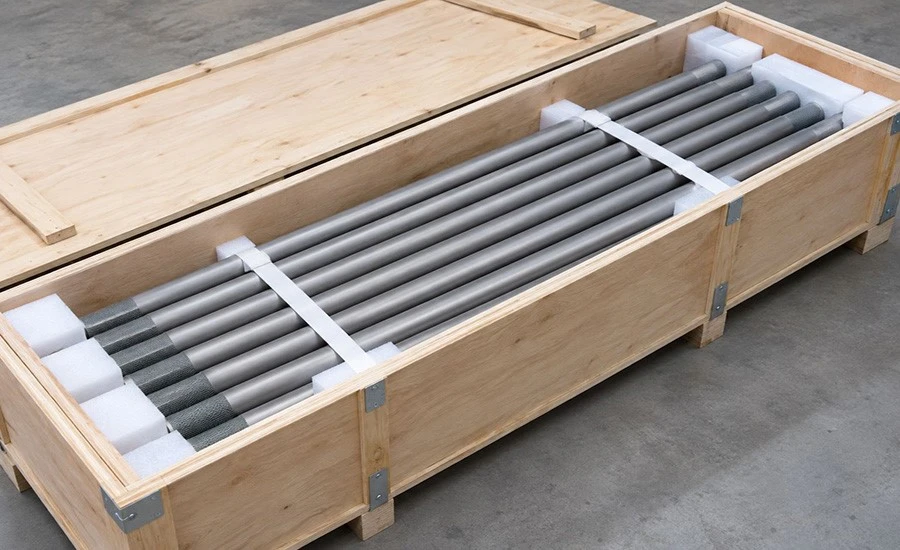
They should also add at least one intermediate saddle in the middle of the rod's span to keep it from sagging when the container is being moved. A displacement gauge put across the rod after uncrating should show zero permanent bending beyond the limit written on the drawing. This is a good acceptance measure that should be pinned to the PO. If the buyer asks, the seller takes a picture of each saddle in place before the case is closed. This picture is used as proof that the deflection-gauge result was due to properly supported stock and not just luck.
Heavy-Bulk, Mixed and Long-Haul Scenarios
Packaging becomes about the interaction between parts in a common volume once batch size exceeds a carton. At this size, rod-to-rod abrasion and crate-level deformation under persistent forklift operation are novel failure mechanisms. Crate-level geometry replaces part-level cradles in protective logic.
Scenario 3 - Mixed multi-piece loads
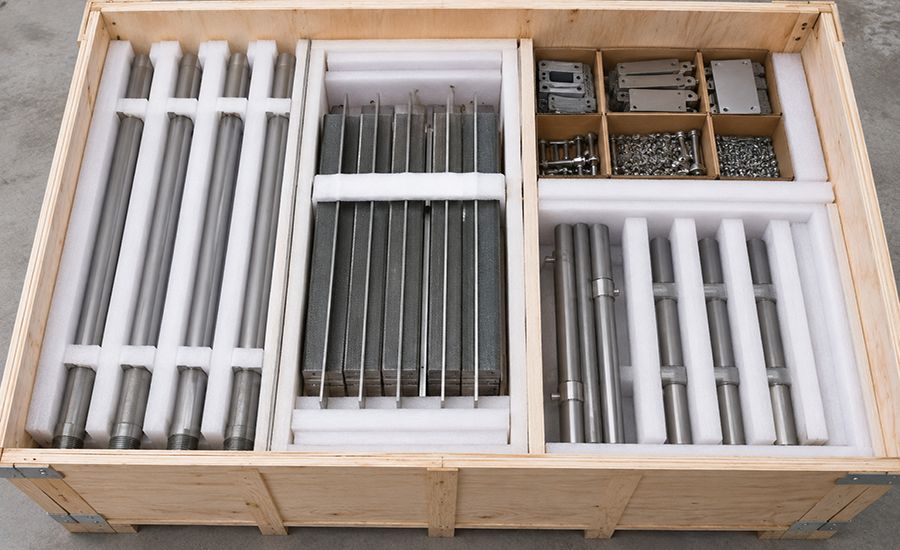
Mixed loads, such three diameters of titanium anode rod and a few bus bars in one export box, need packaging solutions ranging from cleanliness to discipline and reveal a provider's expertise. Physical separation is the solution: corrugated dividers section the interior volume so a 6mm rod cannot touch a 25mm rod, foam cut slots to the rod profile prevent each piece from rotating or sliding during a 30 degree tilt, and a thin PE wrap between rod and foam absorbs the micro-vibration a long sea voyage would transmit directly into the MMO coating. The purchaser should anticipate a top-down photo of the full box before the lid is placed on, with each diameter clearly distinguished.
Scenario 4 - Heavy bulk
A wooden case that holds 200 kg is inappropriate for a 2-ton cargo. This heat-treated wooden box has the ISPM-15 mark the destination phytosanitary authority requires and internal bracing, usually welded steel angles or laminated timber ribs, to lock the rod bundles into a fixed envelope so a 1 m drop does not cause a 200 mm shift inside the case.
The receiving end can move the box with ordinary forks since its footprint fits a pallet, and heavier variations include pre-rigged slings near the center of gravity. ISPM-15 mark, loaded and braced crate picture, and lifting-test certificate provide evidence. A titanium anode rod supplier shipping this much should be able to make all three without asking.
Sea Long-Haul vs. Air Courier: The Two "Environment" Scenarios
The last pair of scenarios in the risk ladder are not really about the rod or the crate - they are about the environment the package lives in for two to six weeks between dispatch and goods-in. Sea freight and air courier invert the protection priority, and the buyer who can name which environment their shipment faces is already past the easiest failure modes.
Scenario 5 - Sea long-haul
Titanium anode rod suppliers with significant export volume restrict the moisture envelope because 40 days at 85 percent relative humidity on a vessel crossing the equatorial belt is the worst-case scenario for sea-route shipments. Sea long-haul protection stack reverses air-courier logic: humidity first, impact second. Each bundle is placed in a heat-sealed aluminum-barrier foil bag with desiccant to lower interior relative humidity below 30% and a humidity indicator card for the receiving inspector to read on opening. To repel salt air, the outside shell is salt-fog-rated or foil-wrapped. Photographs of the indicator card colour sequence during packaging and goods-in prove it.
Scenario 6 - Air courier
Air freight and courier networks prioritise impact and handling above humidity. Airborne anode rod shipments are handled, tilted, conveyor-belted, and stacked more times in 72 hours than sea shipments in 40 days, therefore packing rationale is ISTA-style drop-test rather than sea-route humidity. The pack has double-walled corrugated outers,

foam edge protectors at every corner, an anti-tilt indication that flips if the carton is put on its side, and obvious handling markings where the courier's label won't hide them. A titanium anode rod provider employing this tier should show the customer the carton's qualifiable drop height. Delivery is confirmed by the anti-tilt sticker in place.
Conclusion
Asking for the right packing spec before the PO is signed is not paperwork; it is the cheapest insurance a buyer can buy on an anode rod order. Match the shipment to one of the six scenarios above, pin the matching protection layer and the photo template into the PO rather than a side email, and pre-agree the humidity, drop and impact evidence format for goods-in. A titanium anode rod supplier that already has these answers ready is one who has thought about what happens after the crate leaves the loading bay.
FAQ
1. What is the safest packaging for sample or small-batch titanium anode rod orders?
+
-
For sample or small-batch orders, include vapor-corrosion inhibitors (VCI) sachets per rod, foam cradles of appropriate rod length and corrugated outer boxes with closed-cell foam top and bottom. Photograph each cradle prior to taping the carton, providing the client with a record of the packing which can be compared with the dispatch note and VCI date code.
2. Does ISPM-15 marking apply to every wooden case used for titanium anode rod exports?
+
-
Yes, if the destination country applies IPPC import regulations for solid wood packing material, all wood cases must be marked ISPM-15 (heat-treated or methyl-bromide treated, country code, manufacturer code and treatment code). Without the mark the port may scuttle or fumigate the box, thereby holding up the order.
3. Can the same crate be used for both sea and air freight, or do air and sea routes need different specifications?
+
-
Inverted environment and so features of marine and air routes should be different . Sea freight, humidity and salt-air control (barrier foil, desiccant, salt-fog rated exterior) are top priorities. Impact and handling control are top priorities for air freight.
Ready to lock the right packaging scenario before signing your next PO?
Send the destination port, the batch size, and the longest single-piece length to the NAVI Titanium export desk at sales@navititanium.com, and the team will return a per-scenario packing spec, an ISPM-15 and humidity evidence template, and a reference photograph of a previous shipment that matches the closest of the six scenarios above. NAVI Titanium has been manufacturing ruthenium-, iridium- and platinum-based titanium anode rods out of Baoji since 2008, and our packing practice is built on the same risk-tiering approach. Email the three inputs above and the desk will respond within one working day.
References
1. ICC, *Incoterms 2020*, ICC Publication No. 723E, International Chamber of Commerce.
2. ASTM D4169-23, *Standard Practice for Performance Testing of Shipping Containers and Systems*, ASTM International.
3. ISPM 15, *International Standards for Phytosanitary Measures No. 15 - Regulation of Wood Packaging Material in International Trade*, FAO/IPPC.
4. ASTM D4728-17, *Standard Test Method for Random Vibration Testing of Shipping Containers*, ASTM International.
5. ASTM D7386-16, *Standard Practice for Conditioning Containers, Packages, or Packaging Components for Testing*, ASTM International.
6. ASTM B265-25, *Standard Specification for Titanium and Titanium Alloy Strip, Sheet, and Plate*, ASTM International.



