

Particle size is crucial for developing sintered metal powder filters for hydrogen generation, water treatment, and chemical processing. Knowing how powder parameters affect pore structure isn't just technical-it's essential for effective filtering, flow rates, and product lifespan.
Your filtration system's accuracy depends on sintered metal powder particle size and filter pore structure. This connection affects equipment performance, maintenance costs, and operational efficiency for PEM electrolysis engineers and procurement professionals. A typical filter becomes a precision-engineered component that performs consistently under difficult situations by choosing the proper powder specs.
This detailed reference explains how particle size distribution, powder gradation, and sintering factors form current filtration technology's porous structures. Whether you want micron-level accuracy or high-volume throughput, these concepts will assist you in choosing filter specs and powder.

1.Specification
Product name: Sintered Metal Powder
Internal Code: NAVI-2-002
Brand: NAVI Titanium®
General Shapes: Round, disc, sheet, tube, round, bar, cap or customization
Raw materials:
(1)Titanium---0A grade pure powder
(2)Stainless steel---/SS304/SS316/SS316L etc.
(3)Nickel---Nickel base alloys/MONEL/INCONEL/Hastelloy(C22/C276)
Advanced fields of NAVI: PEM, semiconductor & electronics, pharmaceuticals etc.
2.Purchasing guide
(1)Process
NAVI Titanium(since 2008) can process according to your design drawings
(2)Sample
Effective, economic, high quality
Only take the basic cost of molds for custom product, Sintering together for sample orders, Zero unqualified
(3)Technology support
Professional one-for-one service, welcome to contact us
How Does Sintered Metal Powder Particle Size Determine Filter Pore Size?
During the sintering process, gaps are made between powder particles, which are used as a basic rule for how sintered filter pores are formed. When metal powders are heated slowly below their melting point, the particles stick together where they touch while leaving empty areas between them. These empty areas make up the network of pores that determines how well something filters.
In sintered frameworks, the size of the pores is based on the width of the particles. Studies show that the average pore size in a powder mixture is between 30% and 50% of the average particle diameter. After sintering, a titanium powder with 20-micron particles usually has pores that are 6 to 10 microns wide. Because of this expected connection, engineers can figure out what the filter needs to do by choosing the right powder sizes.
Metallurgical principles say that the relationship between the size of the particles and the structure of the pores is a straight line. Smaller particles are packed closer together, making the spaces between bound particles smaller. This tight packing structure leads to better filtration, but it might also make the material less permeable. On the other hand, bigger particles make bigger empty places, which let more air flow through while lowering the accuracy of the filter.
During sintering, temperature and pressure change this basic relationship. Higher sintering temperatures make it easier for particles to stick together, which slightly reduces the size of the pores as particles change shape and move into empty spaces. Using pressure during sintering also makes the structure tighter, which reduces the number of holes in it. The way NAVI Titanium makes their products carefully manages these factors so that the pores are all the same size and shape from batch to batch.

Material Properties Affecting Pore Formation

Different powder materials sinter in different ways, which changes the end pore shapes. High-purity titanium powder stays very stable in its shape during sintering, which makes uniform pore networks with known properties. Because premium titanium powders don't have a lot of oxygen in them, they don't oxidize too much when heated, which could cause uneven pore surfaces or blockages.
When compared to titanium, nickel-based and sintered metal powders have different sintering rates. To get the same pore structures, these materials usually need to have their processing parameters changed. Stainless steel powder, which is often used in low-cost situations, sinters at slightly higher temperatures but makes sturdy screens that can be used in most industrial settings. The choice of material is based on the needs of the operating environment, such as the need for resistance to corrosion, temperature tolerance, and conductivity.
Sintered Metal Powder Particle Size Distribution for Controlled Porosity
To get reliable filter performance, you need to do more than just choose an average particle size. The porosity, mechanical strength, and repeatability of the filter are all determined by the full particle size distribution profile. A narrow distribution makes pores that are all the same size and work the same way, while a broad distribution makes pores that are all different sizes, which can make precision applications less reliable.
Powders with particles that are all the same size make pore structures that are very uniform, which is great for precise filtration. Most of the particles in these powders are less than 10 microns, which means that the pores are all the same size throughout the filter element. Monodisperse powder systems are very helpful for tasks that need to keep particles in place very precisely, like cleaning water in a PEM electrolyzer.
Different engineering goals are met by polydisperse powders with particles of different sizes. Smaller particles fill in the gaps between bigger ones, making the whole thing denser and stronger while also making it less porous. This method works well for situations where strong filter elements are needed to handle high differential pressures or mechanical stress. The trade-off is a little less permeability and possibly more complicated flow path shapes.
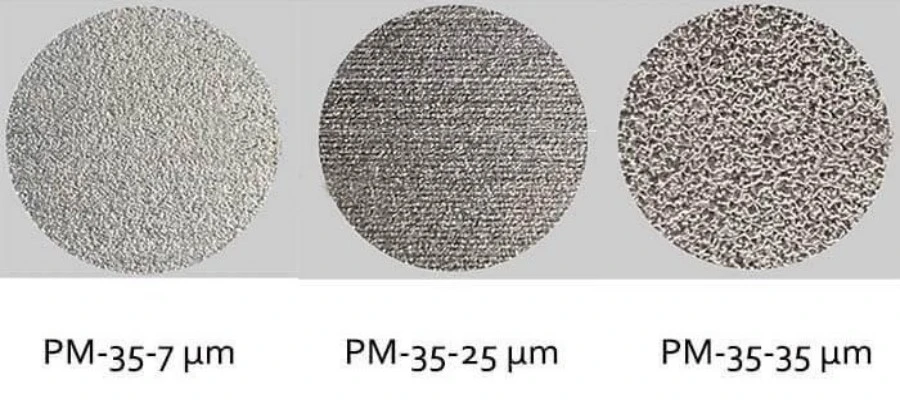
Measuring and Controlling Particle Distribution

Laser diffraction and image analysis are used in modern powder characterization to get very accurate numbers on how the particle sizes are spread out. With these methods, thousands of particles are measured, and statistical profiles are made that show how the particles are distributed. The distribution curve is shown by parameters such as D10, D50, and D90 values. D50 shows the median particle size, and D90 shows the size below which 90% of particles fall.
NAVI Titanium uses strict powder testing methods to make sure that accuracy from batch to batch. Before it is processed, the particle size of each lot of powder is measured, and the acceptance standards must match the goal filter specifications. This way of controlling quality gets rid of differences that might hurt the performance of filters or lead to inconsistent production when making a lot of filters for industrial hydrogen projects.
Engineers can change the ranges of particle sizes to make screens work better for certain tasks. Bimodal distributions, which have two different groups of particles with different sizes, make hierarchical pore structures with both fine and wide channels. This structure lets a lot of fluid move through big pores while still letting particles pass through smaller pores.
PEM electrolysis works best with carefully planned distributions that balance moving water, letting gas out, and electrical conductivity. The porous titanium structures that hold up the catalyst layers must make it easy for water to get to the catalyst layers and for hydrogen and oxygen bubbles to be removed. For these uses, powder distributions focus on uniformity in the 10–30 micron range, which makes the best pore networks for electrochemical performance.

Fine Sintered Metal Powder for Small Pores and Precision Filtration
For precise filtration tasks that need to keep particles below 10 microns, fine metal powders must be used to make sintered porous metal filter elements. The particles in these special powders are usually between 5 and 20 microns across. They make thick microstructures with tightly controlled hole sizes. The filters that come out of this have a high retention efficiency and keep flow rates that are good enough for important applications.

Using small powders in manufacturing comes with its own set of technical difficulties. Smaller particles have more surface area compared to volume, which makes it more likely that oxygen will be picked up during storage and handling. Titanium powder that is very pure and low in air is needed to keep the material's structure and stop contamination. Fine powders sinter at lower temperatures and are more sensitive to changes in the process, so the sintering parameters need to be fine-tuned.
Pharmaceutical processing, semiconductor manufacturing, and the production of high-purity hydrogen all depend on fine-powder filters. These fields need to get rid of all submicron contaminants that might hurt the quality of the products they make or the way their equipment works. An example of how important precision filtration with fine sintered metal structures is is a PEM electrolyzer that supplies fuel cell applications, where trace contaminants severely degrade performance.
How Coarse Sintered Metal Powder Supports Higher Flow Through Porous Filters
For industrial processes that need high volumetric flow rates, coarse metal powders are used to make sintered filter elements. Particles between 40 and 100 microns in size make open-hole structures with low flow resistance. This lets fluids pass quickly while keeping the structure's integrity. These screens work great when getting rid of large particles is more important than keeping small particles.
Coarse powder sintering makes an open structure that lowers the pressure drop across the filter element. This means that less energy is needed for pumping, and the process can go faster. Chemical plants, water treatment plants, and industrial gas systems often use coarse-pore filters for pre-filtration steps or when they need to get rid of particles bigger than 20 to 30 microns.
When working with coarse powders, mechanical strength becomes the most important thing to think about. There are fewer connecting points per unit volume for particles that are bigger, which could make the structure less rigid. Some ways to make up for it are to raise the sintering temperature, use pressure-assisted sintering, or mix powders in ways that add small particles to improve bonding without making pores much smaller. The engineers at NAVI Titanium work to make these factors as good as they can be so that the filters they make meet both flow and strength standards.

Designing 5–80 μm Pore Structures With Controlled Sintered Metal Powder Sizes
It takes careful powder selection and process improvement to make filter elements with specific pore sizes in the 5–80 micron range. This design range includes most industrial filtration needs, from high-precision lab filters to large-scale process equipment. To meet the requirements, you need to know how the powder properties, mixing methods, and sintering conditions work together to create the hole structures you want.
Powder Selection Methodology

Setting a goal pore size based on the needs of the product is the first step in design. The particle-to-pore correlation gives us some basic information: to get pores that are 10 microns wide, we should choose sintered metal powders with particles that are mostly 20 to 25 microns wide. Fine-tuning takes into account how the material sinters and the permeability percentage that is wanted. Because they sinter at different speeds, titanium powders usually need slightly bigger particles than stainless steel powders to get the same hole sizes.
The purity requirements have a big effect on how well the final filter works, especially for electrochemical uses. For the best electrical conductivity and corrosion protection, PEM electrolyzer screens need high-purity titanium powder with little air. When the oxygen content is less than 0.15%, oxides don't form, which could stop electrons from moving or create corrosion sites in specific areas. Higher oxygen levels are okay for most industrial uses, which lets you save money by choosing the right material grade.
Layered powder layering is used to make gradient pore patterns in more advanced filter designs. Coarse powder layers support the structure and allow for high starting flow rates, while fine powder top layers filter with great accuracy. This design takes the best parts of both types of powder and puts them together in a way that makes filters that can hold more dirt and last longer.
To make gradient structures, you need special tools that can spread powder layers one after the other and co-sinter multiple layers at the same time. The interface between layers needs to bond well enough to keep them from coming apart under working forces. Powder suitability and matching sintering properties make it possible to make a gradient filter that works well. The prices for these complex structures are very high, but they work very well in difficult situations.

Process Parameter Optimization

The sintering temperature has a big effect on the finished pore structure. Choosing the right temperature combines the need for good particle bonding for strength with the need for too much sintering, which lowers the number of pores. Titanium sintering usually takes place between 1100°C and 1250°C in a vacuum or an inert atmosphere. Lower temperatures in this range keep the holes bigger, while higher temperatures make the material stronger by making the bonds stronger.
Another control measure is the time spent at the sintering temperature. Longer hold times let more atoms move around, which can strengthen bonds but also make pores smaller. Rapid heating and cooling stop unwanted grain growth while keeping the fine pore structures. NAVI Titanium uses complex furnace control systems that keep the temperature constant within ±5°C. This makes sure that the results are the same for all large production runs.
When filters are finished, they go through a lot of tests to make sure they meet the pore size requirements. Bubble point testing measures the pressure needed to push gas through pores that are full of liquid to find the biggest pore width. The average pore size that affects permeability is found through mean flow pore size testing. Flow resistance is measured during permeability testing, which ensures that the filter meets performance standards.
A close look through a microscope shows the shape, regularity, and possible flaws in the hole structure. Using scanning electron microscopy to get clear pictures of pore networks lets you see if the design was done the way it was meant to be. These quality controls make sure that every filter element that leaves the factory meets strict requirements that are important for customers' use.

Conclusion
Filtering system design depends on sintered metal powder particle size and filter pore shape. By selecting particles and regulating their distribution, engineers may create porous metal filters for high-flow 80-micron structures and exact 5-micron retention.
Matching powder characteristics to performance objectives is key to filtering success. Fine granules are retained precisely for PEM electrolysis, whereas coarse powders allow cost-effective high-flow bulk processing. Complex gradient structures and bimodal distributions increase several performance parameters.
Working with skilled sintered metal filter manufacturers that understand these complex interactions guarantees the highest filter performance. The purity, particle size control, and consistency of materials determine how effectively filters fulfil criteria. Precision-engineered sintered filters will be needed as hydrogen energy and electrochemical technologies advance. Choosing powder will become increasingly important.
FAQ
Q: How precisely can sintered metal powder particle size control the final filter pore dimensions?
+
-
A: With carefully graded powders and modern powder metallurgy techniques, pore size can be controlled to within ±15% of the target specifications. Most of the time, the end pore size is 30 to 50 percent of the median particle width. With less than a 10% difference between batches, NAVI Titanium's quality-controlled powder selection and optimized sintering processes always produce parts with the right pore sizes. Monodisperse powders and gradient structures that reduce pore size distribution are good for applications that need tighter tolerances.
Q: What particle size range works best for PEM electrolyzer filter elements?
+
-
A: Powders between 15 and 35 microns are usually needed for PEM electrolysis uses, which make pores between 5 and 20 microns. This pore size makes it easy for gas bubbles to escape while also distributing water efficiently to the catalyst layers. Titanium powder that is very pure and low in oxygen provides good electrical conductivity and resistance to rust in an acidic electrolyzer. The choice of particles is based on the current density, working pressure, and design of the catalyst layer. The powder standard is then optimized for your system parameters with the help of engineering.
Q: Can sintered metal filters using different powder sizes be combined in a single filtration system?
+
-
A: Filters with increasingly smaller pore structures made from different powder sizes are often used in multistage filtration systems. Large-pore prefilters get rid of big contaminants, which protects fine-pore elements further down the line and makes the whole system last longer. This method improves both performance and cost-effectiveness by using cheap wide filters for the first stage of sorting and precise fine filters only when they are needed. System reliability must be checked by making sure that filter elements are compatible in terms of the material they are made of, the temperature at which they work, and their chemical resistance. NAVI Titanium offers full filtration systems with matched filter parts that are made to work together smoothly.
Ready to Optimize Your Filtration System With Precision-Engineered Sintered Metal Powder?
NAVI Titanium is an expert at making high-performance sintered metal powder filter elements that are exactly what you need. With our knowledge of powder metallurgy and modern sintering technology, we can make screens with controlled pore sizes ranging from 5 to 80 microns. Our engineering team will come up with the best solution for your needs, whether you need high-purity titanium filters for PEM electrolysis or low-cost stainless steel options for industrial processing.
As a reliable supplier of sintered metal powder, we follow strict quality standards that make sure each batch works the same way every time. Our high-purity, low-oxygen titanium powders make steady, regular pore structures that are necessary for demanding electrochemical uses. We can make gradient filters, precision retention elements, or high-flow structures that fit your specific needs thanks to our custom powder grading capabilities.
Get in touch with our expert team right away to talk about your filtering problems. We'll look at your production numbers, working conditions, and performance needs to figure out the best powder specifications and filter design for you. Let NAVI Titanium's knowledge of metals improve the performance and dependability of your system.NAVI Titanium Metal Technology Co., Ltd. can help you with your filter problems because they have decades of experience with powder metallurgy. Get in touch with us at sales@navititanium.com to talk about how our precision-engineered sintered metal powder filters can make your system work better.
References
1. German, R.M. (2014). Sintering Theory and Practice. John Wiley & Sons, New York.
2. Ashby, M.F. & Evans, A.G. (2015). Metal Foams: A Design Guide. Butterworth-Heinemann, Oxford.
3. Nishiyama, Y. & Nakamura, T. (2018). Porous Titanium Materials for Electrochemical Applications. Journal of Materials Science, 53(12), 8629-8645.
4. Smith, J.L. & Thompson, R.W. (2019). Powder Metallurgy Processing of Porous Metals for Filtration. International Journal of Powder Metallurgy, 55(3), 34-48.
5. Liu, H., Chen, Y., & Zhang, W. (2020). Influence of Particle Size Distribution on Pore Structure in Sintered Titanium Filters. Materials Characterization, 168, 110564.
6. Wagner, K. & Mueller, B. (2021). Advanced Sintering Technologies for Precision Porous Metal Components. Powder Technology, 385, 223-237.



