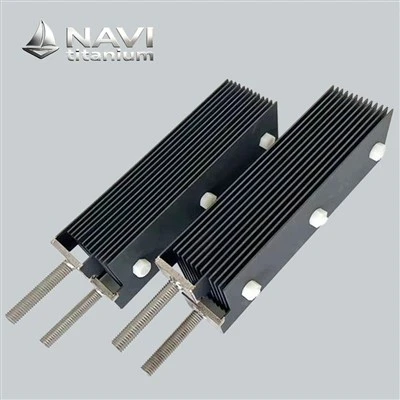


Budgets are tapped out. Production halts. Maintenance staff are stretched thin, changing out electrodes every few months. For operators of around the clock water treatment systems, sodium hypochlorite generators or industrial electrolysis cells, the concern is not whether electrode deterioration occurs, it is how quickly. Titanium anode rods modify that whole equation. These electrodes, with their durable titanium substrate and precisely placed precious metal oxide coating, provide a measurable increase in service life and a reduction in operating cost in a manner that ordinary graphite, stainless steel or lead anodes simply cannot.
This tutorial takes you through the science of coatings, real-world durability statistics and the technical elements affecting the lifespan of a titanium anode rod - so you can make an educated purchase.
How Does Titanium Anode Rod Coating Stability Extend Electrode Life?
The Role of Precious Metal Oxide Coatings
The lifespan of a titanium anode rod is due to the thin but very tough coating of mixed metal oxides (MMO) on its surface. For example, coating formulations of IrO₂-Ta₂O₅ and RuO₂-IrO₂ are applied to the titanium substrate by thermal breakdown to produce a crystalline lattice that resists chemical assault. The coating thickness is usually between 2–15 µm; thin enough to retain the conductivity, but dense enough to prevent penetration of chloride ions and passivation of the substrate.
Research published in the Journal of Applied Electrochemistry confirms that gradient composite MMO coatings significantly reduce coating delamination rates compared to single-layer designs. This is primarily due to each successive layer distributing thermal and mechanical stress across the interface rather than concentrating it at one boundary. This stress-relief architecture is a key determinant of lifetime extension.


Why Coating Adhesion Determines Long-Term Performance
The poor adhesion between the oxide layer and the titanium substrate is the major reason for the premature failure of the electrodes in chlorine evolution and oxygen evolution. Passivation is triggered when microcracks occur, and electrolyte penetrates the interface oxidizing the base metal. Passivation is a nonconductive TiO₂ barrier layer, which quickly destroys electrode efficiency.
NAVI Titanium deals with this via improved substrate pretreatments and surface modifications before coating deposition. The procedures of etching, sandblasting, and chemical activation generate a micro-rough surface structure that increases the real bonding area. The coating therefore demonstrates electrochemical potential stability across a large current density range from 10–50 A/m² to 2,000–5,000 A/m² without any observable delamination under normal working circumstances.
Titanium Anode Rod Durability Under 24-Hour Continuous Electrolysis
Verified Performance in Non-Stop Industrial Cycles
During peak seasons, sodium hypochlorite production for municipal water treatment, marine antifouling and swimming pool disinfection is running constantly without planned downtime. For these circumstances, a titanium anode rod must be resistant to prolonged anodic polarization, hypochlorite back-diffusion and temperature variations without accelerated wear.
Independent accelerated life testing widely cited in the electrochemical engineering literature reveals that ruthenium-iridium titanium anodes maintain over 85% of initial chlorine evolution activity after the equivalent of many years of continuous operation at low current densities. The whole line of ruthenium-iridium titanium anodes of NAVI Titanium are specially developed to work in high salt, strong oxidizing 24 hours continuous electrolysis conditions. System capacity is from 50 g/h to 5,000 g/h of available chlorine.


Corrosion Resistance in Aggressive Electrolyte Environments
Chloride heavy electrolytes are by nature aggressive. Chlorine gas is evolved at the anode surface . This provides a locally acidic microenvironment that would degrade graphite in weeks , and dissolve iron electrodes much quicker . Pure titanium passivates with an oxide skin under anodic bias. With MMO coating the electrode surface is electrochemically active instead of passivating out.
In industrial circulating water treatment or seawater desalination pre-treatment stages, for example, titanium anodes are said to last more than eight to ten years of service under controlled operating conditions, a dramatic improvement over the one-to-two-year replacement cycles typical of uncoated or lead-based electrodes. This durability naturally correlates to decreased spare parts inventories, maintenance shutdowns and personnel costs during the lifetime of the equipment.
How Current Density Affects Titanium Anode Rod Service Life
Operating Within Design Current Density Windows
Current density is the most controllable variable for operators to prolong electrode life. If you run a titanium anode rod above its design ceiling it will speed up the disintegration of the coating via an electrochemical wear process called anodic corrosion. Results from accelerated degradation investigations in leading electrochemical research institutes show that a doubling of an excess current density may lead to a reduction in coating lifetime by a ratio of three to five.
NAVI Titanium anodes are applicable for a wide range of operating current density – from low intensity cathodic protection applications (10–50 A/m²) to high intensity electrolytic metallurgy (2,000–5,000 A/m²). Matching the electrode specification with the actual process current density is a must to achieve rated service life.


Gradient Coating Architecture and Current Distribution
Gradient composite coatings solve the problem of unequal current distribution over the electrode surface. Localized hot spots, regions of excessively high current density resulting from geometric flaws or non-uniform electrolyte flow, lead to accelerated coating deterioration in those particular zones. This impact is mitigated by a multi-layer gradient structure, which gradually modulates the electronic conductivity and catalytic activity from the substrate to the outside, resulting in a more uniform reaction zone and alleviating the localized deterioration.
Titanium Anode Rod Performance with Ruthenium-Iridium and Iridium-Tantalum Coatings
Ruthenium-Iridium Coatings for Chlorine Evolution Applications
Ru-Ir formulations continue to be the industry standard for chlorine evolution reaction (ClER) electrodes. Ruthenium oxide is a great catalyst for the generation of Cl₂ ; iridium oxide offers mechanical toughness and resistance to oxidative dissolution. This combination results in a titanium anode rod with low cell voltage, good current efficiency and consistent long-term output, all of which are key properties for sodium hypochlorite generators under continuous load.
The unit energy consumption for the manufacture of sodium hypochlorite with optimized Ru-Ir titanium anodes is usually in the range 3.2–3.8 kWh·kg⁻¹ of available chlorine, which reduces the operating expenses of the system by 10-25% compared to standard electrode arrangements.
Iridium-Tantalum Coatings for Oxygen Evolution and Water Treatment


IrO₂-Ta₂O₅ modify the electrode selectivity toward oxygen evolution, such that they are the preferable option for electrochemical advanced oxidation processes (EAOP) utilized in the treatment of industrial wastewaters, COD degradation and removal of ammonia nitrogen. Tantalum oxide functions as a structural stabilizer in the coating matrix, preventing grain formation at high temperatures and so retaining catalytic surface area upon long term operation.
The iridium-tantalum titanium anode rod provides a uniform oxidation efficiency with little sludge production for printed circuit board manufacturing, pharmaceutical effluent treatment, and semiconductor rinse water polishing – a real plus for operations that have stringent discharge compliance requirements.
What Makes a Titanium Anode Rod Suitable for Long-Term Electrolysis?
Material Selection: Pure Titanium Gr1 as the Optimal Substrate
The choice of substrate is fundamental. For adherence of MMO coatings industrial pure titanium Grade 1 (TA1) provides the best compromise between corrosion resistance, ductility and surface reactivity. The passive oxide layer formed during anodic polarization inhibits dissolving of the substrate and is thin enough to provide a good electron transfer between the coating and the current collector.
NAVI Titanium has selected Gr1 pure titanium as the standard substrate material for the anode rod product line, providing a single substrate material for the whole range of electrolysis settings from dilute saline pools to intense chlor-alkali brines.
Design Flexibility and Application Compatibility
The titanium anode rod appropriate for long-term use must also satisfy the physical and hydraulic limits of the electrolytic cell.

Rod shape electrodes are well suited to tubular electrolyzers and to cathodic protection systems for pipeline infrastructure, water heater tanks and submerged maritime constructions. Titanium cladding of copper composite rods with a titanium shell of 1.0-1.2 mm thickness on the surface of a copper core provides surface corrosion resistance and enhances electrical conductivity for high current applications.
The geometric modification of plates, rods, meshes and tubes is included in NAVI Titanium. This enables designing electrode assemblies to specified reactor volumes, flow velocities and current distributions. This flexibility is a practical benefit for system integrators who require drop-in compatibility with current infrastructure, rather than expensive cell redesigns.
Conclusion
A titanium anode rod with a well designed MMO coating is not only a longer lasting electrode – it is an investment in the whole system that decreases energy consumption, lowers maintenance cycles, and avoids hidden costs of frequent electrode replacement. The number of years of dependable service an anode provides is a function of coating stability, quality of substrate preparation, coating formulation choice and current density control. When these parameters are properly tuned, operators may obtain service lifetimes of 8–10 years, a unit energy consumption of 3.2–3.8 kWh/kg and a noticeable decrease of 10–25% in total operating expenses.
FAQ
Q1: How long does a titanium anode rod typically last in continuous water treatment service?
+
-
Under controlled operating conditions - appropriate current density, stable electrolyte concentration, and proper system maintenance - a ruthenium-iridium titanium anode rod lasts 8–10 years. Cathodic protection applications in soil or seawater can extend service life beyond 50 years due to lower current demands.
Q2: What is the difference between ruthenium-iridium and iridium-tantalum coatings on a titanium anode rod?
+
-
Ruthenium-iridium coatings are optimized for chlorine evolution reactions and are the standard choice for sodium hypochlorite generation and chlor-alkali processes. Iridium-tantalum coatings favor oxygen evolution and are preferred for electrochemical oxidation in wastewater treatment, where selective organic matter degradation is the primary objective.
Q3: Can a titanium anode rod replace a lead anode in electroplating applications?
+
-
Yes. Titanium anode rods with platinum or ruthenium-iridium coatings are a direct, more environmentally responsible replacement for lead anodes in copper plating, chrome plating, and gold plating processes. They eliminate lead contamination risk, reduce sludge output, and offer longer service life without the toxicity concerns associated with lead-based electrodes.
Ready to Reduce O&M Costs? Partner with NAVI Titanium
If rising electrode replacement costs and unplanned maintenance shutdowns are limiting your operation, NAVI Titanium has a direct solution. As a professional titanium anode rod supplier established in 2008 and headquartered in China's premier titanium manufacturing hub - Baoji High-tech Zone - NAVI Titanium combines over 15 years of coating technology expertise with full in-house manufacturing capability. Every anode ships with stable electrochemical potential, verified coating adhesion, and a service life validated for 8–10 years in demanding continuous electrolysis environments. Whether your application is municipal water disinfection, industrial wastewater oxidation, seawater desalination, or cathodic protection, NAVI Titanium engineers a solution matched to your exact operating parameters - at no design charge.
Contact NAVI Titanium's technical team today for a free consultation or a complimentary sample of standard specifications:
References
1. Trasatti, S. (1991). Physical electrochemistry of ceramic oxides. Electrochimica Acta, 36(2), 225–241.
2. Beer, H. B. (1980). The invention and industrial development of metal anodes. Journal of The Electrochemical Society, 127(8), 303C–307C.
3. Comninellis, C., & Vercesi, G. P. (1991). Characterization of DSA-type oxygen evolving electrodes: Choice of a coating. Journal of Applied Electrochemistry, 21(4), 335–345.
4. Panić, V. V., Dekanski, A. B., Milonjić, S. K., Mišković-Stanković, V. B., & Nikolić, B. Ž. (2005). The influence of the aging time of RuO₂ and TiO₂ sols on the electrochemical properties and behavior for the chlorine evolution reaction of activated titanium anodes. Electrochimica Acta, 50(23), 4379–4388.
5. Lipp, L., & Pletcher, D. (1997). The preparation and characterization of tin(IV) oxide coated titanium electrodes. Electrochimica Acta, 42(7), 1091–1099.
6. Xu, L., Zhao, Y., Deng, J., & Feng, C. (2016). Electrocatalytic degradation of industrial wastewater using dimensionally stable anodes: A review of recent progress and challenges. Journal of Hazardous Materials, 318, 104–120.