NAVI Titanium's titanium footpegs KTM are built on the brand's deep expertise in titanium forging, precision machining, and surface treatments. They pack serious features like being lightweight, impact-resistant, corrosion-proof, and slip-resistant into every detail. From picking raw materials, shaping, heat treating, forming anti-slip teeth, to final quality checks, they've built production standards that handle the toughest off-road conditions. On top of that, they've got special packaging and shipping plans designed for titanium parts, making sure each set of footpegs reaches dealers, custom shops, and riders worldwide with the same precision and look as when they left the factory.
Solutions of NAVI Titanium
The academic connections strengthen NAVI Titanium's engineering knowledge and provide a scientific basis for continuous product development.


NAVI Titanium approaches advanced off-road component development through the study of metallic structural behaviour, cyclic loading characteristics, and rider-induced mechanical stress.


Application
Titanium footpegs KTM are the only part in the whole riding setup that serve all four functions at once: supporting weight, transferring force, providing feedback, and ensuring safety. The rider's weight is transmitted to the frame through them, and all of the rider's fine adjustments to the bike's posture-shifting weight forward and backward, pressing down into turns, leaning the bike before jumps, lifting it out of tricky spots-happen through them. They also send the road feedback from the bike back to the rider's feet. They sit at the point of most frequent contact between rider and bike, experiencing the most complex forces and harshest conditions: when you press down, they carry your full body weight; when you're in the air, they take the landing impact; when you're riding, they endure constant vibrations; and when you stop, they get soaked in mud and water.
The key stance for off-road and trail riding is the standing position. When standing, the pedal shifts from being just a 'place to put your foot' to becoming 'the support surface for your entire body'-calves grip the bike, knees are slightly bent, and the soles bear the weight. The rider uses the triangle formed by the pedals and handlebars to counter bumps and lateral forces from the trail. This sets certain requirements for the pedals: the platform needs to be large enough to support the whole boot sole (not just the front part), the anti-slip pins must grip even through muddy boots, and the pedal must be able to withstand the multiplied dynamic load of standing. The NAVI Titanium platform is designed with enough width and length for standing, and the pins are arranged in a staggered 3D pattern so the sole always has multiple contact points under pressure at any angle. This creates a subtle but important effect: your foot doesn't have to constantly adjust to find the right spot when standing, so the rider can focus entirely on the trail. During long trail rides, this kind of stability is far more valuable than any single spec.

Key points for handling jumps, drops, and landing impacts

KTM's off-road and freeride bikes often face jumps, drops, and a series of bumps. The moment you land, the rider's entire weight plus the vertical acceleration concentrates on the pedals, with peak loads far exceeding the static weight. The challenge for pedals isn't whether they'll bend, but whether they can spring back after bending and withstand repeated impacts without accumulating fatigue. This is where titanium's high strength-to-weight ratio really shines. Titanium's density is about 60% that of steel for the same volume, and with proper heat treatment and forging control, alloys like Ti-6Al-4V can reach or even surpass the tensile strength of typical structural steels. This means that for the same load capacity, the pedals can be made thinner and lighter while still keeping enough elastic deformation range. Upon landing, the pedals undergo controlled elastic deformation and recover, instead of directly bending plastically or cracking like some aluminum parts.
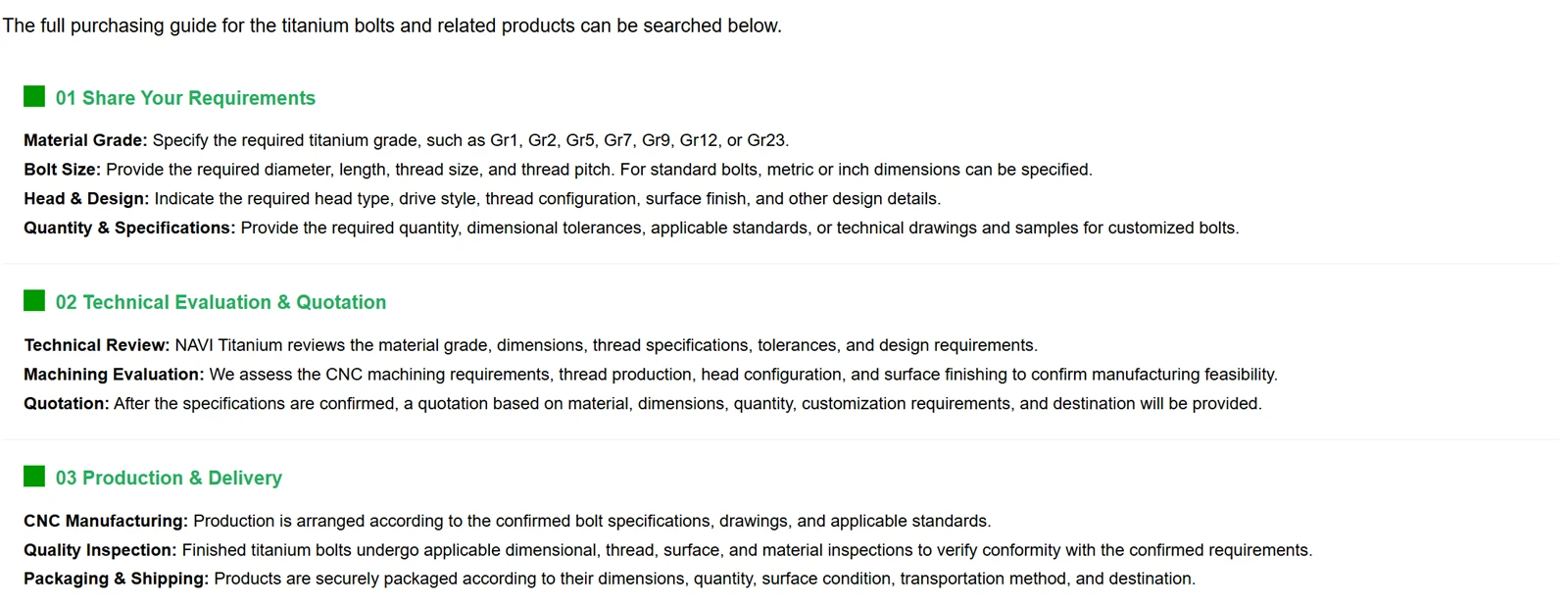
Purchasing guide
Quality control (QC)
NAVI Titanium maintains a technical documentation framework for alloy traceability and compositional verification, particularly relevant to lightweight components used in European motocross equipment channels such as 24MX.

Manufacturing Process
The manufacturing process begins with the selection of aerospace-grade alloy stock, followed by controlled cutting and precision machining to establish the primary structural profile. Advanced milling operations create the supporting ribs, contact projections, and mounting interfaces, while carefully regulated machining parameters limit residual stress and excessive material removal. Subsequent grinding and abrasive treatment refine edge transitions and contact areas, reducing localized stress concentrations. Particular attention is given to the distribution of load-bearing sections, as motocross footrests experience repeated impacts, vibration, and concentrated rider pressure.
Selection Guide
Titanium footpegs KTM are high-strength load-bearing parts. When selecting and installing them, the key parameters to check focus on six areas: vehicle compatibility, base material properties, platform and tooth geometry, installation fit, surface treatment, and maintenance cycle. The table below outlines, item by item, the reference requirements, things to watch out for, consequences of improper use, and the control standards of NAVI Titanium, so that modification shops, teams, and end users can cross-check them during purchase, installation, and re-inspection.
| Parameter | Reference Specification & Control Standard | Key Notes | Risks of Wrong Selection / Improper Operation | NAVI Titanium Control Statement |
| Compatible Model & Year | Matched hole pitch and bracket angle by individual KTM model, displacement and frame revision | Brackets may be revised among different production years for the same model; verify frame serial number or original footpeg before ordering | Forced reaming or random shimming leads to abnormal rebound and limit failure after installation | Mold development filed by model and year; hole pitch and positioning angle replicated per OEM bracket drawings |
| Base Material Grade | Ti-6Al-4V (Grade 5) titanium alloy for billet | Distinguish alloy titanium from pure titanium; pure titanium lacks sufficient strength for load-bearing footpegs | Mixed low-grade raw material causes bending or cracking under impact | Spectral composition inspection for incoming billets; full batch traceability with material test certificates |
| Unit Weight | Lightweight design under equal strength; final weight calculated according to structure and model | Do not compare nominal weight only; check cross-section and platform area simultaneously | Excessive lightweight design sacrifices rigidity and triggers excessive deformation upon landing | Optimized forging grain structure and cross-section, balancing strength and weight |
| Platform Dimension (L × W) | Large enough to fully support off-road boot sole with reserved space for forward / backward standing posture | Narrow platform reduces stability; oversize platform interferes with frame, skid plate or side stand | Insufficient contact area forces constant foot adjustment; collision and interference caused by overwidth | Platform contour designed following KTM ergonomics and mainstream off-road boot sizes |
| Cleat Height & Pitch | Balanced biting performance and mud discharge; spacing reserved for clay extrusion | Over-sharp teeth cut boot soles; dense teeth trap mud and form slippery mud pad; shallow teeth lose grip on wet surface | Slippage, accelerated boot wear or failed self-cleaning during riding | Staggered 3D cleat profile with blunted tips; pitch optimized for automatic mud removal |
| Mounting Hole Pitch / Shaft Diameter / Limit Slot | Identical to OEM shaft and limit geometry; no frame modification required | Measure shaft diameter and slot position before installation to check deformation | Forced assembly crushes base, accelerates shaft wear and causes sticking rebound | 5-axis CNC finishing; hole pitch and coaxiality inspected piece by piece before shipment |
| Installation Torque | Fastened within recommended torque range per fastener grade; neither over-tightened nor loose | Over-torque crushes base; loose fasteners back out under vibration; anti-loose hardware mandatory | Base crack, rattling footpegs or accidental detachment under extreme conditions | Installation guide and matched hardware included; recommended torque clearly marked |
| Spring & Rebuild Mechanism | Smooth rebound without jamming; inspect springs and circlers regularly | Sand and mud invading the pivot weaken rebound over time; periodic cleaning and lubrication required | Footpeg fails to flip back, shifting the supporting point for standing riding | Rebound feel sampled one by one; matched springs, circlers and pivot pins fully inspected |
| Surface Treatment | Passivation or optional anodizing; all edges and cleat tips deburred | Anodizing color comes from light interference of oxide film; no primer peeling after abrasion | Sharp burrs scratch boot surface; coated alternatives produce patchy rust once worn through | Degreasing, pickling and passivation; optional anodized coloring; scratch surface restorable by polishing |
| Corrosion Resistance | Resistant to mud, salt spray, post-race cleaners and high-humidity environments | Pay extra attention to long-term performance under chloride cleaners, deicing salt and coastal conditions | Pitting on aluminum variants; rust spreading once coating fails on steel footpegs | Self-healing passive oxide layer formed naturally; finished products sampled for salt spray aging test |
| Load & Fatigue Performance | Withstand dynamic load from standing, landing and lateral bending | Separate static load limit and cyclic fatigue load; overload and repeated minor vibration belong to two failure modes | Sudden fracture of aluminum parts; fatigue crack along cleat root of steel weldment | Forging microstructure control, static load test and fatigue sampling; controlled deformation as the primary failure mode |
| Auxiliary Hardware | Complete set including pivot pins, springs, circlers, gaskets and fixing bolts | Verify material and anti-loose design of accessories to avoid makeshift replacement | Premature corrosion or insufficient strength of small parts leads to total assembly failure | Full set supplied with packing list; spare parts available for separate purchase |
| Cleat Wear & Maintenance Cycle | Check cleat height, root crack and platform deformation frequently; reshape or replace when heavily worn | Cleat abrasion is normal consumption under heavy use; do not delay maintenance until slippage occurs | Reduced grip force; higher risk of slipping during cornering and standing riding | Reshaping and inspection guidance attached; clear threshold for replacement |
| Galvanic Corrosion Control | Use matched isolation gaskets and lubricant when contacting steel brackets and fasteners | Galvanic corrosion may occur at the contact interface if titanium couples with dissimilar metals for long periods | Local corrosion or seizure at contact points | Isolation gasket and installation specification provided to mitigate interfacial risks |
Frequently Asked Questions
Q1: How does NAVI Titanium ensure product quality?
+
-
NAVI Titanium controls material quality, machining accuracy, dimensions, and surface finish through production inspections to ensure consistent product quality.
Q2: Are titanium footpegs suitable for off-road riding?
+
-
Yes. Titanium offers high strength, lightweight construction, and corrosion resistance, making it suitable for motocross, enduro, and trail riding.
Q3: How should titanium footpegs be maintained?
+
-
Regularly clean the footpegs and inspect mounting points, fasteners, and surfaces for cracks, deformation, or excessive wear.
Q4: How are footpegs packaged for transportation?
+
-
NAVI Titanium uses protective packaging to minimize scratches, friction, and impact damage during storage and international transportation.
Q5: What shipping methods does NAVI offer?
+
-
NAVI Titanium can arrange express, air freight, or sea freight according to order quantity, destination, and customer delivery requirements.
Hot Tags: titanium footpegs ktm, China titanium footpegs ktm manufacturers, suppliers, factory