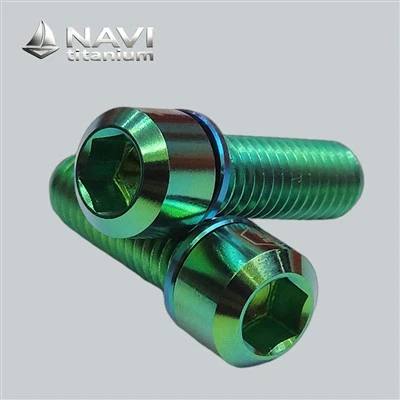


Titanium CNC machining parts are components shaped from titanium bar stock, plate, or forgings on computer numerical control machine tools. A CAM program converts the drawing into a toolpath, and the machine then turns, mills, drills, taps, and bores the part to the programmed dimensions without an operator steering every cut. NAVI Titanium runs CNC turning centres for bolts, screws, nuts, and studs, three- and four-axis machining centres for brackets, flanges, sleeves, shafts, and adapter blocks, and five-axis machines for angled and thin-wall assemblies. Every batch is produced from mill-certified stock and inspected against the approved drawing before packing, with material certificates, dimensional reports, and shipping documents travelling with the goods. Changeover between jobs is handled by pre-set fixtures and a stored program library, so a repeat order starts cutting on the first day.
Solutions of NAVI Titanium
Grade 5 Ti-6Al-4V is the grade we machine most often. It delivers roughly 900 MPa tensile strength, dependable fatigue behaviour, and about half the density of steel, which makes it the default choice for fasteners and loaded structures. Titanium cuts differently from steel: low thermal conductivity keeps heat at the cutting edge, so we run lower surface speed, a heavier feed per tooth, and high-pressure coolant to protect the tool. Grade 2 commercially pure titanium suits chemical, marine, and medical support hardware where corrosion resistance matters more than strength.


NAVI Titanium builds to your drawing, your 3D model, or a physical sample. A custom CNC project opens with a technical review: we check wall thickness, thread engagement, tolerance stack-up, and whether the geometry can be cut in fewer setups, then return a quotation with the proposed process route. Our programmers write the CAM toolpath, model the fixture, and simulate the cycle before metal is cut, which catches collisions and over-travel on the screen instead of on the machine.


Application
Titanium CNC machining parts are chosen wherever weight, corrosion resistance, and strength must hold at the same time. Aerospace uses them in airframe brackets, actuator housings, and engine accessories. Medical work depends on them for implants, surgical instruments, and imaging hardware. Semiconductor plants specify titanium for wafer handling fixtures and cleanroom components. Chemical processing relies on CNC machined valve bodies, pump parts, and heat exchanger fittings because the metal resists chlorides and oxidising acids. Marine and offshore projects use titanium for propeller shafts, seawater piping, and subsea connectors.
Aerospace buyers specify titanium for two properties: strength-to-weight ratio and fatigue performance. A bracket machined from Grade 5 weighs about half its steel equivalent, which lowers structural mass and the fuel needed to carry it. Titanium also holds strength where aluminium softens, so hardware near bleed air ducts and hydraulic lines is frequently titanium. On the machine, risk concentrates in thin sections and long flanges: cutting force deflects the wall, the tool chatters, and a compliant section becomes an out-of-tolerance one. We control this with light radial engagement, climb milling, adaptive clearing, and fixtures that support the part on both faces. Five-axis setups keep angled features in one datum instead of three. Reports record bore position, wall thickness, and surface finish, and first-article packages ship with every lot. Toolpaths are proven on a test block before the first aerospace part is cut. The specific situation will depend on the particular order.

Medical

Medical applications divide into implants, instruments, and equipment. Implant components use Grade 23 Ti-6Al-4V ELI or Grade 4 because the extra-low interstitial chemistry improves biocompatibility and fatigue life, and the machined surface is usually fine-polished or given an anodised oxide layer. Surgical instruments need stiffness in a thin profile, so titanium replaces stainless steel where weight in the surgeon's hand affects control. These parts are cut with small-diameter solid carbide tools at high spindle speed, and the toolpath is kept smooth so the surface carries no residual chatter marks. Imaging and laboratory equipment uses titanium fixtures that will not disturb a magnetic field or corrode through repeated autoclave cycles. Medical machining also demands contamination control: no iron from tooling on the part, clean coolant, and documented Ra values before cleaning and lot segregation. Deburring is done by hand under magnification rather than by tumbling, since a tumbled edge can round a cutting surface.
Purchasing guide

Quality control (QC)
NAVI Titanium keeps a complete set of documented technical records to ensure full traceability and operational consistency for all CNC titanium parts. Each batch includes raw material certificates, machining process logs, dimensional inspection reports and surface treatment records. We can provide these documents upon request, helping you verify material grade, machining parameters and test results, and meet strict quality audit requirements for aerospace, chemical, medical and electrochemical projects.

Manufacturing Process
CNC machining begins with programming and material verification: the mill certificate is checked against the grade, blanks are sawed or waterjet cut, and the CAM program is proven on the first piece.
Turning establishes the axis and reference diameter; milling and five-axis work cut pockets, slots, and angled features in one setup where possible, which holds position tight.
Roughing removes bulk with adaptive toolpaths, then a finishing pass with a fresh carbide tool sets the final dimension and finish.
Threads are rolled or cut according to load, and critical bores are finished with a boring head rather than an end mill.
Deburring follows, then stress relief, then passivation, anodising, or PVD coating.
Final inspection uses a CMM, a profile projector, and thread gauges, and Tools are chosen per feature: solid carbide for finishing, inserted cutters for roughing, a boring head for round holes.
NAVI TItanium Technical Support
Technical support is part of the purchase, not an optional extra. Before quotation, our engineers read the drawing against the application and flag anything that would raise CNC titanium machining cost or shorten service life: an undercut the tool cannot reach, a thread pitched too close to a shoulder, a wall too thin to hold without chatter, a tolerance tighter than the process can repeat. During production, larger orders receive progress updates with photographs at agreed milestones.
| Titanium CNC Machining Parts – Specifications | |
|---|---|
|
Category |
Specifications / Options |
|
Material Grades |
Grade 1, Grade 2, Grade 3, Grade 4, Grade 5 (Ti-6Al-4V), Grade 23 (Ti-6Al-4V ELI) |
|
Raw Material Forms |
Titanium Bars, Plates, Sheets, Tubes, Forgings |
|
CNC Machining Processes |
CNC Turning, CNC Milling, 3-Axis, 4-Axis and 5-Axis Machining, Drilling, Boring, Tapping |
|
Part Types |
Titanium Bolts, Screws, Nuts, Studs, Flanges, Brackets, Shafts, Sleeves, Adapter Blocks |
|
Machining Tolerance |
According to customer drawings and project requirements |
|
Surface Finish |
As-Machined, Polished, Sandblasted, Anodised, PVD Coated |
|
Thread Types |
Metric, UNC, UNF and Custom Threads |
|
Customization |
Custom Dimensions, Geometries, Threads and Surface Treatments |
|
Quality Inspection |
CMM Inspection, Profile Projector, Thread Gauges, Dimensional Inspection |
|
Documentation |
Mill Test Certificates (MTC), Dimensional Inspection Reports, Certificates of Conformity |
|
Production Volume |
Prototype Samples, Small Batches and Mass Production |
|
Applications |
Aerospace, Medical, Semiconductor, Chemical Processing, Marine and Offshore |
Design review is where most of the CNC value is created. We ask for the function of each feature, not only its dimension, because function decides which tolerance can be relaxed and which cannot. A locating bore needs a controlled diameter and position; a clearance hole for a cover does not. When a customer sends a STEP file without a drawing, we mark the critical dimensions ourselves, send the list for confirmation, and cut metal only after the customer signs it. We also test whether the part can be machined from stock bar instead of a forging, which often removes weeks from lead time. Cost drivers such as five-axis access, walls under 2 mm, deep pockets, and fine surface finish are quoted separately, so the buyer can weigh each requirement against its price. If the batch is large, we cut a sample and send the CMM output before the balance is machined.

Documentation and After-Sales

Order documentation and after-sales questions for titanium CNC machining parts are handled by the same team. Each shipment carries a material certificate, a dimensional report covering the dimensions agreed at review, and, where requested, a certificate of conformity with RoHS or REACH statements. If a part fails incoming inspection, we compare the report against the drawing, establish whether the deviation is dimensional, cosmetic, or a documentation gap, and respond with a replacement, concession request, or corrected certificate. On repeat orders the approved revision and CAM program stay on file, so a change is flagged before cutting starts rather than after shipment. Buyers who need guidance on torque, thread lubrication, or coating thickness receive a written recommendation they can forward to their own engineering team. Records are archived for five years. Where a customer runs the same part every quarter, we keep the fixture and tool list ready so restart is immediate.
FAQ
What is the minimum order quantity, and how are small batches priced?
-
Prototypes and small batches start from one piece. Pricing depends on material, geometry, tolerance, and surface treatment rather than on quantity alone, so the same part can cost more at ten pieces than at five hundred. We quote tiered prices at one, ten, one hundred, and one thousand pieces in a single offer, which lets buyers compare the cost of a trial run against a production order before committing.
Which titanium grade should I specify for my part?
-
Grade 5 Ti-6Al-4V covers most structural and fastener work. Choose Grade 2 when corrosion resistance and formability matter more than strength, Grade 9 for thin-wall tube and frame parts, and Grade 23 or medical grades for implant and instrument components. If the application is unusual, send the operating conditions and we will recommend a grade with the reasoning attached.
What tolerances and surface finishes can your CNC machines hold?
-
Critical dimensions are held to plus or minus 0.01 mm, with tighter limits available on request after a capability check. Surface finish reaches Ra 0.4 on turned and ground features, and Ra 1.6 on milled surfaces. Standard CNC finishes include passivation, bead blasting, anodising, and PVD coating, and we state the achievable range on the quotation so it is agreed before production.
How long does production take, and which terms do you support?
-
Sampling usually takes seven to twelve working days after drawing approval, and repeat batches five to ten days depending on quantity and material availability. We ship on EXW, FOB, CIF, and DAP terms, by air or sea, with express couriers for small parcels. Lead time is confirmed in writing with each order, and delays are reported as soon as they appear.
What documents accompany each shipment?
-
Every shipment includes a material certificate with the heat number, a dimensional report covering the dimensions agreed at review, a packing list, and a commercial invoice. Certificates of conformity, RoHS and REACH statements, and first-article inspection reports are supplied on request. Buyers who need a specific format can send their template, and we complete it before dispatch.
Hot Tags: titanium cnc machining parts, China titanium cnc machining parts manufacturers, suppliers, factory