


When developing a new electrolysis system, engineers often start with a standard electrode size. But once the electrode enters the actual equipment, installation space, current distribution, connection points, and operating conditions may require a different configuration.
This is a common issue NAVI Titanium encounters when working with international customers. An MMO titanium mesh anode may be technically suitable for an application, yet a standard size or structure may not fit the customer's equipment.
For these projects, customization is not simply about changing dimensions. It is about connecting the electrode design with the actual electrochemical system.
A Standard Product Does Not Always Fit the Equipment
Electrolysis equipment can vary significantly from one project to another. Some systems use compact reaction chambers, while others require large electrode areas or unusual installation positions.
Typical customer requirements may include:
|
Customer Requirement |
Possible Customization |
|
Limited installation space |
Non-standard length, width or profile |
|
Irregular reaction chamber |
Special mesh shape or structural cutting |
|
Existing equipment |
Matching original mounting dimensions |
|
Different current density |
Appropriate coating configuration |
|
Special power connection |
Customized connection position or structure |
|
New equipment development |
Small-batch prototype production |
This is why NAVI Titanium often begins a custom project with the customer's drawing rather than a standard product number.
Start With the Customer's Drawing or Operating Data
A professional engineering drawing is helpful, but it is not always necessary at the beginning.
Customers may provide a CAD drawing, basic dimensional sketch, existing electrode photograph, or information about their operating conditions. These materials give the engineering team a starting point for evaluating the required configuration.
The key information normally includes:
Electrode dimensions and available installation space
Electrode spacing
Operating current or current density
Electrolyte and reaction environment
Connection method
Continuous or intermittent operation
The purpose is not to complicate the purchasing process. It is to understand how the MMO titanium mesh anode will actually work inside the equipment.
A small dimensional change can sometimes affect installation, while coating selection needs to correspond with the intended electrochemical reaction and operating environment.
Why Mesh Design Matters
An MMO titanium mesh anode provides an open electrode structure that can offer substantial active surface area while allowing electrolyte movement through the mesh.
However, mesh electrodes are not limited to one universal geometry.
Depending on the equipment, NAVI Titanium may produce:

Standard mesh
→ Conventional rectangular configuration
→ Common installation structure
→ Suitable for established equipment designs

Customized mesh
→ Non-standard dimensions
→ Irregular profiles
→ Special mounting or connection areas
→ Multiple sections or application-specific structures
For equipment manufacturers developing new systems, the second option can be particularly useful because the electrode can be designed around the equipment instead of forcing the equipment to accommodate a standard electrode.
Coating Selection Is Part of the Engineering Discussion
Another frequent customer question concerns MMO coating selection.
Different electrochemical applications can require different catalytic systems. Depending on the operating conditions and intended reaction, customers may discuss ruthenium-iridium, iridium-tantalum, or other coating configurations with NAVI Titanium.
The coating should therefore be considered together with the application rather than selected only according to the electrode's appearance or substrate material.
|
Project Information |
Why It Matters |
|
Electrolyte |
Helps define the operating environment |
|
Current density |
Relevant to electrode configuration |
|
Electrochemical reaction |
Influences coating selection |
|
Electrode spacing |
Affects system arrangement |
|
Operating schedule |
Helps define application requirements |
|
Equipment structure |
Determines dimensions and connections |
Providing this information early allows the engineering team to discuss a more appropriate configuration before production begins.
Delivery Is More Than Sending a Finished Product
For a customized electrode, delivery begins before the product leaves the factory.
NAVI Titanium coordinates the key technical and commercial information before production, including:
Order Confirmation
Drawing + dimensions + coating + connection + quantity
01
Production
Titanium substrate preparation + mesh forming + coating process
02
Inspection
Dimensions + appearance + coating-related requirements + agreed specifications
03
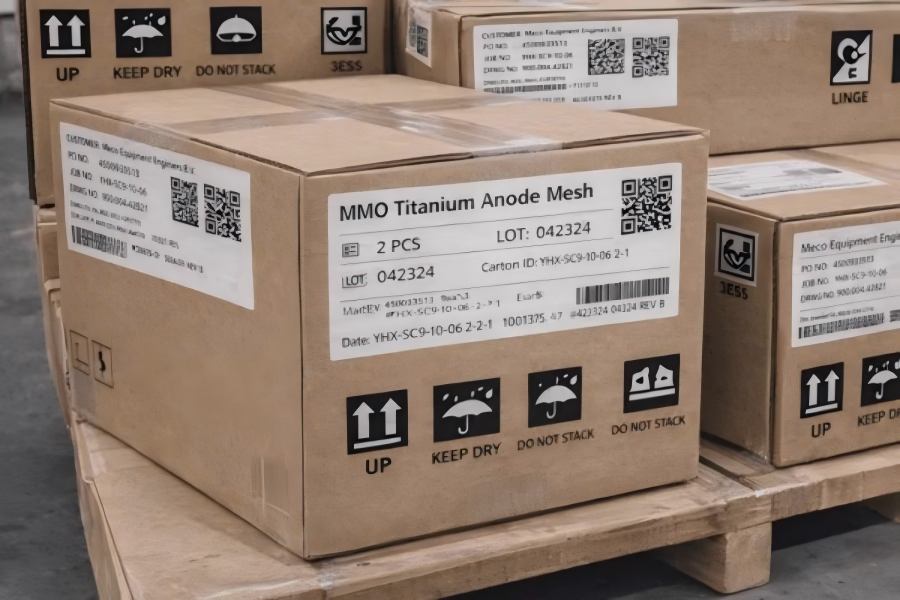
Protective Packaging
Protection against deformation and handling damage
04
Shipment
Shipping documents + tracking information + delivery coordination
05
This process is particularly important for mesh electrodes because improper handling or excessive pressure during transportation can affect the electrode structure.
For international customers, shipment coordination and documentation are therefore treated as part of the overall supply process rather than as an afterthought.
What NAVI Titanium Learns From Customer Projects
One practical lesson from custom electrode projects is that the first specification is not always the final specification.
A customer may initially send only an electrode photograph. Another may provide a basic drawing without complete operating data. After discussing the equipment, additional requirements can emerge.
For NAVI Titanium, these discussions are valuable because they provide a clearer understanding of how the electrode will be used.
The engineering process can therefore move from:
"Can you manufacture this size?"
to: "How should this electrode be configured for your equipment?"
That difference matters when the electrode is part of a larger electrochemical system.
The power supply, electrolyte, electrode spacing, tank structure, circulation conditions, connection method, and operating schedule all interact with the anode. Looking at the electrode separately may therefore overlook important installation or operating considerations.
From Prototype to Repeat Supply
Once a customized MMO titanium mesh anode passes customer validation, consistency becomes the next priority.
For equipment manufacturers, the same electrode may later be required for multiple machines, replacement orders, or different project batches.
NAVI Titanium can use the confirmed configuration as the basis for repeat production, helping customers avoid restarting the technical discussion for every order.
This is particularly useful when a prototype has already been tested and approved by the customer's engineering team.
The objective is to move smoothly through three stages:
|
Stage |
Main Customer Need |
|
Prototype |
Confirm fit and technical configuration |
|
Validation |
Test the electrode within the actual system |
|
Repeat Supply |
Maintain the approved configuration |
Start With the Information You Have

Customers do not always need a complete engineering package before contacting NAVI Titanium.
A drawing, photograph, equipment dimension, basic operating data, or even a simple hand-marked sketch can provide a useful starting point.
From there, the engineering team can discuss dimensions, mesh structure, connection requirements, coating options, sample quantities, and delivery arrangements.
For NAVI Titanium, customization is not simply a manufacturing service. It is part of the communication process between the electrode supplier and the equipment team.
When an MMO titanium mesh anode needs to fit a specific electrolysis system, the most useful first step is often not choosing a catalog item. It is sharing the application information and discussing the actual engineering requirement.
NAVI Titanium supports customers from technical discussion and prototype development through inspection, shipment, and repeat supply.



