


1. Engineering Background: Why Bushing Selection Matters
In rotating and reciprocating mechanical systems, bushings serve as essential bearing components that support shafts, reduce friction, and maintain stable movement. Their performance directly affects equipment efficiency, maintenance frequency, and component service life. Among the available bearing solutions, sintered bronze bushings are widely used in applications requiring compact structures, continuous lubrication, and reduced maintenance. Unlike conventional machined bronze bushings, they feature a porous metal structure capable of retaining lubricating oil within the material. However, this design also introduces specific considerations regarding load capacity, operating speed, temperature, and lubrication conditions. For equipment manufacturers, the key question is not simply which bushing is stronger or less expensive, but whether the bearing structure matches the actual operating requirements.
2. Sintered Bronze Bushings: Structure and Working Principle
Sintered bronze bushings are manufactured using powder metallurgy. Bronze powder is first compacted into a predetermined shape under controlled pressure and then sintered at a temperature below the melting point of the material. During sintering, the metal particles bond together while maintaining interconnected pores throughout the structure. These pores form an internal oil-storage network that distinguishes sintered bronze bushings from conventional solid bronze bearings.
After sintering, the bushings are typically impregnated with lubricating oil under controlled conditions.
During operation, frictional heat and movement help release the stored oil from the internal pores toward the bearing surface. This creates a lubricating film between the shaft and the bushing, reducing direct metal-to-metal contact. When the equipment stops, capillary action helps draw oil back into the porous structure.
This continuous oil circulation mechanism allows sintered bronze bushings to operate with limited routine lubrication, making them particularly useful in equipment where maintenance access is restricted.
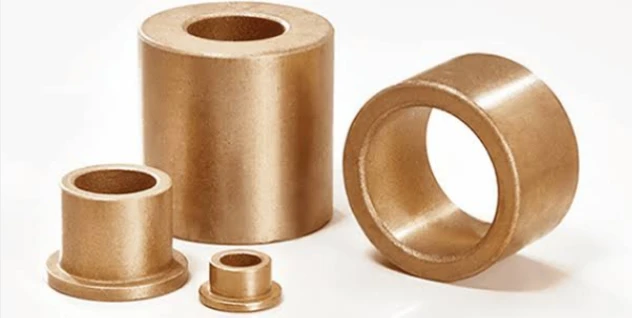
2.2 Porosity and Bearing Performance
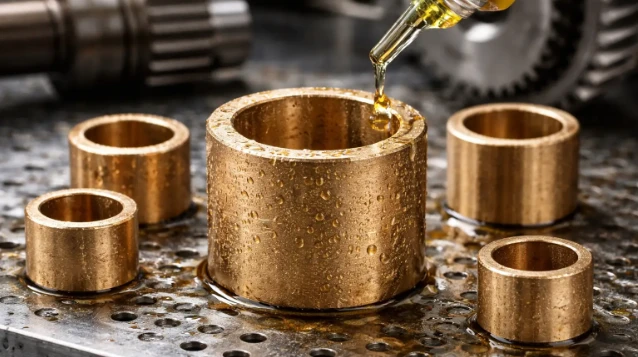
Porosity is one of the most important characteristics of sintered bronze bushings. It determines the available oil-storage capacity and influences the mechanical properties of the finished component.
Higher porosity can provide greater oil-retention capacity, but it may also reduce the effective load-bearing cross-section. Conversely, lower porosity can improve structural density while reducing the available oil-storage volume.
Therefore, porosity should be controlled according to the intended application rather than maximized without considering mechanical requirements.
The balance between porosity, material density, oil impregnation, and dimensional accuracy is essential for achieving consistent bearing performance.
3. Sintered Bronze Bushings vs. Machined Bronze Bushings
Although both types are used as sliding bearing components, their internal structures and lubrication methods create different engineering characteristics.
|
Parameter |
Sintered Bronze Bushings |
Machined Bronze Bushings |
|
Manufacturing process |
Powder metallurgy |
Conventional machining |
|
Internal structure |
Porous |
Dense and solid |
|
Lubrication |
Oil-impregnated structure |
Usually external oil or grease |
|
Oil storage |
Internal interconnected pores |
No inherent porous oil-storage structure |
|
Maintenance |
Generally reduced routine lubrication |
Depends on lubrication arrangement |
|
Load capacity |
Generally suited to light-to-medium loads |
Can be designed for higher loads |
|
Production |
Efficient for suitable batch production |
Flexible for custom dimensions |
|
Typical use |
Motors, fans, small mechanical drives |
Heavy machinery and specialized mechanisms |
The main advantage of sintered bronze bushings is their integrated lubrication capability. Instead of relying entirely on external lubrication systems, they store oil within their own porous structure. Machined bronze bushings offer greater flexibility in solid-material selection and specialized geometries. They are often more suitable when high mechanical strength or specific structural configurations take priority over self-lubrication. For applications where low maintenance and compact bearing design are important, sintered bronze bushings can provide a more practical engineering solution.
4. Engineering Applications of Sintered Bronze Bushings
The porous structure and oil-impregnated design make sintered bronze bushings suitable for various mechanical systems. Their application depends on bearing pressure, shaft speed, operating temperature, and lubrication requirements.
4.1 Electric Motors and Small Drive Systems
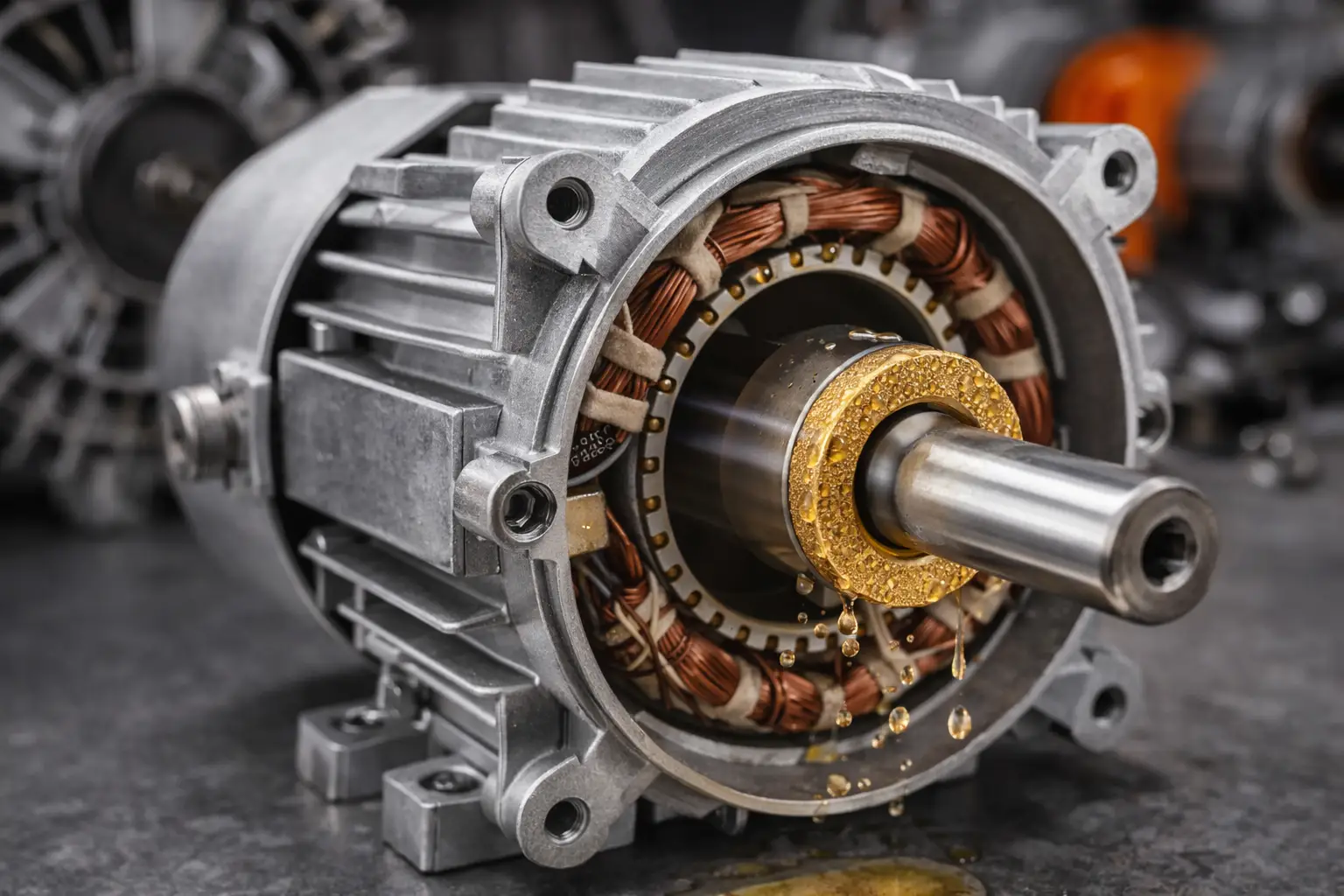
Electric motors frequently use compact bushings to support rotating shafts and maintain stable alignment. In small motors, fans, and blowers, oil-impregnated sintered bronze bushings can provide continuous lubrication without requiring a complex external lubrication arrangement. Their compact structure and relatively low maintenance requirements make them suitable for high-volume electromechanical equipment.
4.2 Household Appliances and Office Equipment
Household appliances and office automation equipment often contain small rotating or reciprocating mechanisms that operate for extended periods. Sintered bronze bushings can help reduce friction and support smooth movement in components such as fan motors, small drive assemblies, and mechanical transmission systems. Their ability to retain lubricating oil is particularly useful in applications where frequent maintenance is impractical.
4.3 Automotive Auxiliary Components
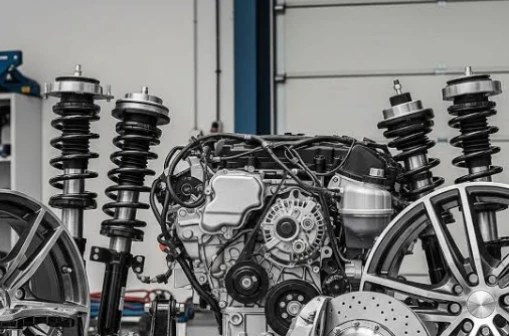
Certain automotive auxiliary mechanisms require compact bearing components capable of operating with limited maintenance. Sintered bronze bushings can be used in selected motors, actuators, and other mechanical assemblies where their operating conditions are compatible with the material's performance limits. Material selection must account for temperature fluctuations, vibration, shaft speed, and the compatibility of the impregnated oil with the working environment.

5. Key Engineering Factors When Selecting Sintered Bronze Bushings
Selecting a sintered bronze bushing requires more than matching the inner and outer diameters. Several technical parameters influence its operating performance.
Bearing Pressure
The applied load and projected bearing area determine the operating pressure. Excessive pressure may accelerate wear or cause structural damage.
Sliding Velocity
Shaft speed affects frictional heat generation and oil-film stability. The allowable speed must be evaluated together with bearing pressure.
PV Value
It is an important reference for evaluating operating conditions.The actual allowable PV value depends on material characteristics, lubrication, and heat dissipation.
Operating Temperature
Temperature influences oil viscosity, lubrication performance, and oxidation rate. The selected impregnating oil must be suitable for the operating environment.
Porosity and Oil Content
These parameters influence oil storage and release behavior. They should be controlled to meet the intended service conditions.
Shaft Surface Finish and Clearance
Proper shaft finish and running clearance help maintain a stable lubricating film and reduce uneven wear.
Evaluating these parameters together helps engineers determine whether an oil-impregnated sintered bronze bushing is appropriate for a specific mechanical system.
6. Manufacturing Considerations for Customized Sintered Bronze Bushings
Consistent manufacturing quality is essential for achieving reliable performance in sintered bronze bushings. The production process generally involves bronze powder preparation, powder compaction, sintering, sizing or calibration, cleaning, oil impregnation, and final inspection. Each stage influences the finished component. Powder characteristics and compaction conditions affect the initial density and pore distribution. Sintering parameters determine the bonding between metal particles, while sizing helps achieve the required dimensional accuracy. Oil impregnation then establishes the internal lubrication capacity. For customized components, manufacturers must also consider bushing geometry, wall thickness, dimensional tolerances, porosity requirements, and the intended operating conditions. These factors should be evaluated together rather than treated as independent manufacturing specifications.
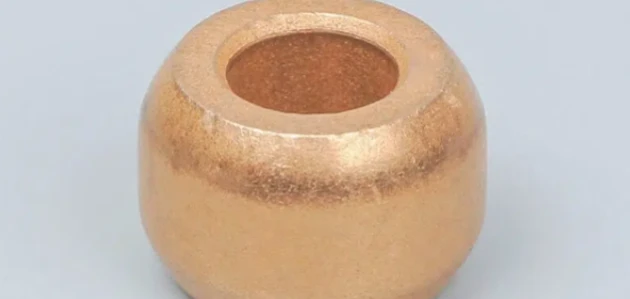
7. Customized Sintered Bronze Bushing Solutions from NAVI Titanium
NAVI Titanium provides customized sintered metal manufacturing solutions for industrial applications. For sintered bronze bushings, we focus on the relationship between porous structure, oil-retention characteristics, component dimensions, and application requirements.
Our customization services support different bushing geometries and technical specifications, including:
Inner diameter, outer diameter, and overall length.
Customized cylindrical and other suitable geometries.
Porosity and oil-impregnation requirements.
Dimensional tolerances and surface finish.
OEM and ODM production based on drawings or samples.
For projects involving non-standard bushings, customers can provide technical drawings, physical samples, or operating parameters for manufacturing evaluation. By considering the intended working conditions alongside component specifications, NAVI Titanium works with customers to develop suitable sintered bronze solutions for their mechanical equipment.
Contact NAVI Titanium to discuss your sintered bronze bushing project and request a customized manufacturing evaluation.



