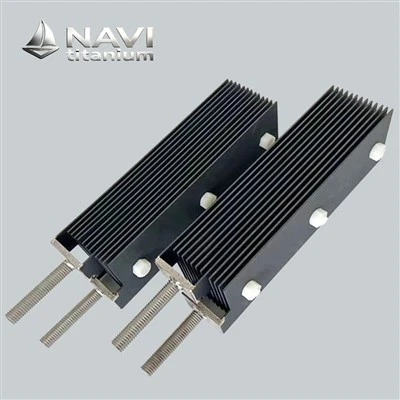

Learn how to select a titanium anode rod by substrate, MMO coating, active area, current density, application environment, connection and service life. NAVI Titanium provides custom titanium-based anode rods for electrochemical and cathodic protection systems.

Titanium Anode Rod
1.Specification
General Shapes: Plate, Rod, Mesh, Tube or customization
Coating: The classical formula of IrO2-Ta2O5, Ru-Ir, Pt, or customization
Electrochemical reaction: Oxygen/Chlorine/Hydrogen evolution reaction
Internal Code: NAVI-1-011
Brand: NAVI Titanium®
Basic Material: Pure Titanium Gr1
Advanced fields of NAVI: PEM, PCB, wastwater treatment etc.
2.Purchasing guide
(1)Process
NAVI Titanium(since 2008) can process according to your design drawings
(2)Free sample
NAVI Titanium supply free sample for general specifications
(3)Technology support
Professional one-for-one service, design free, welcome to contact us
1. What Is a Titanium Anode Rod?
Titanium anode rod is a cylindrical electrode made from a titanium substrate and coated with an electrochemically active coating. In many industrial applications, the titanium substrate is protected by a Mixed Metal Oxide (MMO) coating, allowing the rod to function as a dimensionally stable anode.
The titanium substrate provides mechanical strength and corrosion resistance, while the functional coating determines the electrochemical behavior, reaction suitability, current output and expected service life.
| Part |
|
|
| Substrate |
|
Provides mechanical support and corrosion resistance |
| Active Coating | Ru-Ir, Ir-Ta or other MMO systems | Provides electrochemical activity |
| Rod Body | Solid cylindrical form | Provides compact active surface |
| Connection | Thread / cable / terminal / tab |
|
| Sealing Area | Epoxy / heat-shrink / project-specific sealing | Protects the electrical connection |
| Mounting | Threaded, suspended, inserted or fixture-mounted | Fits the installation system |
Titanium is commonly selected as the substrate because the base material can maintain its dimensional form under many electrochemical operating conditions while providing a suitable surface for an active coating.
The final performance, however, is not determined by the titanium substrate alone. Coating formulation, coating loading, active area, current density and operating environment must be evaluated together.NAVI Titanium can supply titanium-based anode rods according to required diameter, length, coating, active area, connection and installation configuration.
2. Why Choose?
A rod-shaped anode is particularly useful when the equipment requires a compact cylindrical electrode rather than a large flat or mesh active surface.
When a Rod Configuration Makes Sense
| Requirement | Why a Rod Anode May Fit |
| Limited installation space | Cylindrical geometry occupies relatively little space |
| Localized current output | Active area can be concentrated along a defined length |
| Small electrochemical cells | Easy to position inside compact equipment |
| Equipment integration | Diameter and length can be matched to existing openings |
| Threaded installation | Rod ends can be manufactured for mechanical fastening |
| Cable-connected installation | Suitable for remote power connection |
| Cathodic protection | Can provide controlled current to selected protected areas |
| OEM replacement | Diameter, length and connection can follow an existing sample |
Buyers should evaluate:
Application → Environment → Reaction → Required Current → Active Area → Current Density → Coating → Connection → Design Life
This prevents the common mistake of selecting an anode only according to physical dimensions.
3. Titanium Anode Rod Forms


| Rod Form |
|
|
| Standard Rod |
|
General electrochemical equipment |
| Threaded Rod |
|
Replaceable or fixed installation |
| Cable-Connected Rod | Cable attached to the electrode | ICCP and remote installation |
| Terminal Rod | Electrical terminal incorporated into the end |
|
| Extended Rod |
|
|
| Short Rod |
|
|
| Drawing-Based Rod | Produced according to engineering drawing | OEM and replacement projects |
The rod diameter, total length and coated length do not necessarily need to be identical to the customer's existing electrode. They should be evaluated against the required current output, available installation space and operating conditions.
4. Titanium Anode Rod Coating Comparison
The coating is one of the most important factors when selecting a titanium anode rod.
Different electrochemical reactions require different catalytic characteristics. Therefore, the coating should be selected according to electrolyte chemistry, reaction type, current density, temperature and required operating life.
| Coating System |
|
|
| Ru-Ir Coating |
|
Chloride-containing electrolytes, disinfection, electrolysis |
| Ir-Ta Coating |
|
Water treatment, electrochemical oxidation, selected CP systems |
| Pt-Based Coating |
|
Specialized electrochemical applications |
| Other MMO Systems |
|
|
| Coating Selection Should Consider | |
| Parameter | Why It Matters |
| Electrolyte | Determines chemical compatibility |
| Chloride Concentration | Influences reaction behavior and coating selection |
| pH | Affects electrochemical operating conditions |
| Temperature | Can influence coating consumption and reaction kinetics |
| Current Density | Directly affects active coating loading requirements |
| Main Reaction | Determines the appropriate catalytic system |
| Required Service Life | Influences coating formulation and loading |
Important: There is no universally"best"coating. The correct coating is the one matched to the actual electrochemical environment.
5. How to Select the Right Titanium Anode Rod?
Selecting a titanium anode rod should start with the operating conditions rather than the rod dimensions alone. The appropriate electrode is determined by the relationship between the application, electrolyte, required current, active area, coating system and installation method.
Step 1: Define the Application
First identify what the anode is expected to do.
Common applications include:
- Impressed-current cathodic protection
- Water treatment
- Electrolysis
- Electrochemical oxidation
- Disinfection
- Heat exchanger protection
- Condenser protection
- Process vessel protection
- OEM equipment
- Replacement projects
Different applications can require different coating systems and operating parameters, even when the physical shape of the electrode looks similar.


Step 2: Check the Operating Environment
The electrolyte has a direct influence on coating selection and expected service life.
For water-based applications, consider:
Freshwater / Brackish Water / Seawater / Chemical Electrolyte
The key information includes:
- Electrolyte composition
- Chloride concentration
- pH
- Temperature
- Conductivity
- Flow conditions
- Operating hours
For soil-based cathodic protection, soil resistivity and backfill conditions should also be considered.
Step 3: Determine the Electrical Requirement
The required current is another important selection parameter.
A larger rod does not automatically mean better performance. The active surface area needs to correspond to the required current and allowable current density.
The basic selection relationship can be understood as:
Required Current → Active Area → Current Density → Coating System → Expected Service Life
If the required current is known, NAVI Titanium can evaluate the appropriate active length, rod diameter and coating configuration.
Step 4: Confirm the Physical Dimensions
After the operating requirements are established, determine:
- Rod diameter
- Overall length
- Coated length
- Active area


- Connection position
- Installation space
For replacement projects, customers can provide an existing anode, drawing or dimensional information. This makes it easier to reproduce the required configuration accurately.
Step 5: Select the Coating
The coating should be selected according to the dominant electrochemical reaction and operating environment.
For example, Ru-Ir MMO may be considered for applications involving chlorine-related electrochemical reactions, while Ir-Ta MMO can be considered for oxygen-evolution-oriented applications and selected demanding environments.
The final choice should be based on the actual electrolyte and operating parameters rather than coating name alone.
6. Where Are Titanium Anode Rods Used?
Industrial buyers often require an electrode that fits an existing system rather than a generic standard size.
NAVI Titanium can adjust the titanium anode rod according to the customer's technical requirements.


Cathodic Protection
MMO-coated titanium rods can be used as impressed-current anodes for protecting conductive structures from corrosion.
Typical applications include:
Heat exchangers
Condensers
Process vessels
Cooling systems
Water tanks
Selected marine or seawater systems
The anode configuration is normally determined by the required current, protected surface area, electrolyte conductivity and target design life.
Water Treatment & Disinfection
Rod anodes can also be incorporated into compact electrochemical water treatment equipment.

Their cylindrical form allows the active surface to be positioned inside a relatively small reaction chamber. Coating selection depends on the intended electrochemical reaction and water chemistry.
Electrolysis & Electrochemical Systems
In electrolysis systems, the anode participates directly in the electrochemical reaction. The coating therefore needs to be selected according to the electrolyte and intended reaction.
For OEM equipment, the rod can be manufactured according to the available chamber dimensions, required active area and electrical connection.
| Typical Application Matching | |
| Application | Main Selection Considerations |
| Cathodic Protection | Current, electrolyte, protected area, design life |
| Heat Exchanger Protection | Water chemistry, installation space, current |
| Seawater Systems | Salinity, temperature, current density |
| Water Treatment |
|
| Electrolysis | Reaction, current density, coating system |
| OEM Replacement | Drawing, sample, dimensions, connection |
7. How Can a Titanium Anode Rod Be Customized?
Industrial buyers often require an electrode that fits an existing system rather than a generic standard size.
NAVI Titanium can adjust the titanium anode rod according to the customer's technical requirements.

Dimensional Customization
The basic dimensions can be modified according to the installation space:
Diameter → Overall Length → Coated Length → Active Area
The coated length can also be different from the total rod length when only part of the electrode needs to be electrochemically active.
Coating Customization
Depending on the application, NAVI Titanium can evaluate different coating systems and coating loading requirements.
The selection can consider:
- Electrolyte chemistry
- Target reaction
- Current density
- Temperature
- Operating hours
- Required design life
Connection Customization
The electrical connection is particularly important for OEM and replacement projects.
Available configurations can include:
- Threaded connection
- Cable connection
- Terminal connection
- End connection
- Project-specific connection
The connection position, thread specification, cable length and sealing arrangement can be adjusted according to the installation requirements.

Drawing or Sample-Based Customization
For customers replacing an existing electrode, the easiest approach is often to provide:
- Existing Anode / Sample → Drawing → Operating Data → NAVI Titanium Evaluation → Production
Photos can also be provided as an initial reference, while dimensional drawings or physical samples are preferable for precise reproduction.