

Modern water treatment requires electrochemical accuracy, not guesswork. Municipal plants, industrial facilities and recreational water systems have made the titanium anode rod the electrode of choice among engineers who require steady performance under demanding working circumstances. This article discusses how these rods operate, where they are most effective, and what purchasers should be aware of when picking a coating, all drawing on actual electrochemical data and field application logic.
How Is a Titanium Anode Rod Used in Electrochemical Wastewater Treatment?
The Electrochemical Role at the Anode Surface
When a direct current is sent through an electrolytic cell, oxidation processes are driven at the surface of the anode. The titanium anode rod is covered with mixed metal oxide (MMO) , usually iridium and ruthenium oxides, which catalyses either the oxygen evolution process or the chlorine evolution reaction depending on the electrolyte composition. In the case of saline wastewater, the chloride ions are oxidised to active chlorine species that target the dissolved pollutants. Under low chloride conditions, the hydroxyl radical formed at the anode surface is the main oxidant.
This dual-pathway capacity is another reason electrochemical oxidation is used in contemporary wastewater facilities rather than numerous typical chemical dosing processes. The anode is not consumed in the process, since the titanium substrate stays dimensionally stable even after years of constant polarisation.
Why Titanium Outperforms Competing Substrate Materials
Graphite erodes fast with anodic polarisation and carbon particles pollute the water being treated.

Stainless steel dissolves iron and chromium ions into the electrolyte, causing secondary pollution. Heavy metal toxicity has resulted in the banning of lead anodes, previously a mainstay in electroplating, from most water treatment applications. Copper corrodes quite fast in oxidising electrolytes.
Pure titanium (grade 1 or 2) provides a passive oxide layer which shields the substrate from corrosion, whilst the precious metal coating retains its electrical conductivity. A suitably coated titanium anode rod provides constant electrochemical performance that competing materials just cannot maintain, with a cell resistance of as low as < 0.02 Ω, and working current densities from 10 A/m² all the way up to 5,000 A/m².
Titanium Anode Rod Applications in Swimming Pool and Drinking Water Disinfection

Electrolytic Chlorination: The Mechanism Behind the Clean Water
Salt-chlorination systems in swimming pools transfer a dilute brine solution over the surface of a titanium anode rod to produce sodium hypochlorite in situ. The hypochlorite concentration may be accurately controlled by optimising the flow rate and current density, eliminating the danger of over-dosing associated with bulk chemical addition. The research reported verifies what the electrochemical engineering literature regularly shows: that in-situ electrolytic production of hypochlorite produces microbial inactivation rates more than 99.9% for major pathogens prevalent in recreational water.
The same technique of electrolysis has been employed in drinking water treatment facilities for the final disinfection stages, especially in distant locations where the transportation of chemicals is logistically challenging. Titanium anode rod formats are available in plate, mesh, tube or rod geometries, giving plant designers the ability to incorporate electrodes into existing infrastructure without substantial civil alterations.
Operational Advantages Over Chemical Dosing
Facilities shifting from bulk hypochlorite supply to on-site electrolytic production of hypochlorite have reported considerable savings in chemical handling costs and storage dangers. The electrode system functions on a continuous basis, supplying stable disinfectant levels rather than spikes after hand additions. A good titanium anode rod will have a covering that will outlive any other electrode material in the high-pH, chloride-rich environment of a sodium hypochlorite generator – maintaining stable output for thousands of hours of operation.
Can a Titanium Anode Rod Support Organic Pollutant Degradation in Industrial Wastewater?
Electrochemical Advanced Oxidation for High-COD Effluents
Industrial wastewater of pharmaceutical, textile and chemical manufacturing industries typically shows significant loads of chemical oxygen demand (COD) which cannot be efficiently handled by biological treatment alone. Electrochemical advanced oxidation processes (EAOPs) use titanium anode rod as a source of hydroxyl radicals and other reactive oxygen species that may mineralise refractory organic molecules. Studies from environmental engineering departments at different Chinese and European universities have indicated that electrochemical reactors with MMO-coated titanium anodes operated at controlled current densities may achieve COD reduction rates of more than 80%.
Ammonia nitrogen removal happens by a similar mechanism where active chlorine created at the anode reacts with ammonium ions by the breakpoint chlorination chemistry to reduce ammonia to nitrogen gas without sludge formation. This feature directly reduces downstream sludge management costs, which constitute a large budget line item in industrial wastewater budgets.

Coating Selection for Aggressive Industrial Matrices
Not all industrial streams with high COD and conductivity have coatings of the same quality. Ruthenium-iridium formulations perform well in chloride rich environments. Platinum coated rods are employed in sulphate or perchlorate electrolytes where ruthenium leaching might become a concern. Iridium-tantalum coatings exhibit increased durability against oxygen evolution when the process is driven toward direct anodic oxidation instead of mediated chlorination. The chemistry of the coating has to be adapted to the specific pollutant matrix, which is not optional, as it directly influences the lifespan of the electrode and energy efficiency.
Titanium Anode Rods for Seawater Systems and Industrial Circulating Water Treatment

Antifouling and Corrosion Protection in Marine Environments
Impressed current cathodic protection (ICCP) and electrochlorination are employed to control both corrosion and biofouling in seawater systems, such as desalination intake structures, offshore platforms, and ship hulls protection. The titanium anode rod of a seawater electrochlorination unit creates hypochlorite directly from the chloride naturally found in seawater, therefore eliminating the need for any chemical inputs at the installation site. It is recommended by engineers as the first option for marine infrastructure due to its resistance to sea water corrosion and a documented service life of over 50 years for cathodic protection installations.
Scaling, microbial growth and corrosion - the 'three enemies' of heat exchanger efficacy – are common problems in circulating cooling water systems in industry. Electrochemical treatment with titanium anode rods addresses all three at the same time. Active chlorine suppresses biofilm; anodic oxidation modifies scale precursors; impressed current protects metal surfaces.
System Design Considerations for High-Salinity Streams
Greater electrolyte conductivity, resulting from high salinity streams, results in lower cell voltage and reduced energy usage per unit of active chlorine generated. For these circumstances, NAVI Titanium's ruthenium-iridium titanium anode rods are developed with gradient composite coatings that retain activity in continuous 24-hour operation throughout the complete range of salinities seen in saltwater and brine applications.
How Should Buyers Match Titanium Anode Rod Coatings to Water Treatment Conditions?
Reading the Process Chemistry Before Specifying a Coating
The coating on a titanium anode rod isn't for looks, it's the catalytic engine of the electrode. Buyers that specify the improper coating will suffer from early passivation, increased energy usage and early replacement cycles. The basis is always the electrolyte composition: the chloride content, pH range, temperature of operation and the electrochemical reaction we are trying to achieve (chlorine evolution, oxygen evolution or direct oxidation).
Ruthenium-iridium coatings are the workhorses of chlor-alkali and sodium hypochlorite applications because they have a low chlorine evolution overpotential, which means less electrical energy is wasted as heat and more is put into productive chemistry. The standard of choice for oxygen evolution in water electrolysis and certain metal recovery applications is iridium-tantalum coatings. In applications where platinum coatings are required, the ultrahigh purity of the treated stream is crucial.
Practical Buying Guidance for Project Engineers

Coating thickness needs are determined by the current density range. Low current cathodic protection applications may accept thinner coatings (2 to 5 µm) but high intensity industrial electrolysis units need up to 15 µm coatings with gradient stress-relief architecture to avoid delamination during thermal cycling. NAVI Titanium provides free samples for standard specifications, enabling project engineers to evaluate the performance of the electrodes in their real process environment before full-scale purchase.
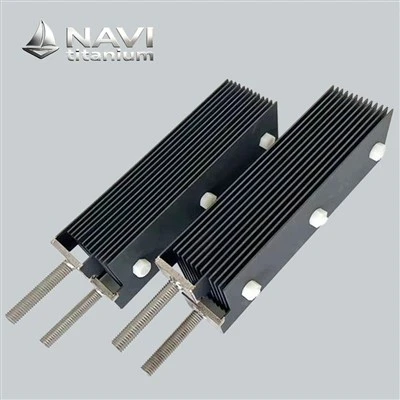
Titanium clad copper composite rod (titanium shell 1.0-1.2 mm, copper core) Where composite conductivity requirements dictate that current distribution across long runs of electrodes requires lower ohmic resistance, the titanium clad copper composite rod provides a practical solution without sacrificing corrosion resistance at the electrode surface.
Conclusion
The electrochemical adaptability and proven long-term stability of the titanium anode rod have secured its place at the heart of modern water treatment equipment. Low energy consumption, extended service life, no secondary pollution-this is the constant performance record from sodium hypochlorite production in swimming pools to organic pollutant elimination in pharmaceutical wastewater, from seawater antifouling to industrial circulating water management. The choice of coating remains the important variable - match the chemistry to the process and the electrode will deliver on its promise.
FAQ
1.What is the typical service life of a titanium anode rod in a sodium hypochlorite generator?
+
-
A well maintained electrolytic sodium hypochlorite system with a suitably coated ruthenium-iridium titanium anode rod will normally provide 8-10 years of active service before replacement of the coating is necessary under continuous 24 hour operation. Actual life is dependent on current density, electrolyte temperature and maintenance standards.
2.Can a titanium anode rod be used in both chlorine evolution and oxygen evolution applications?
+
-
The substrate is compatible with both reactions, but the coating chemistry dictates the favoured reaction. Chlorine evolution is optimised using ruthenium-iridium formulations, whereas iridium-tantalum coatings are used for oxygen evolution processes such as water electrolysis. The selection of the proper coating for the desired reaction is important for energy efficiency and electrode life.
3.Does NAVI Titanium supply custom-dimensioned titanium anode rods for non-standard cell designs?
+
-
NAVI Titanium produces titanium anode rods in plate, rod, mesh, tube and entirely bespoke geometries, machining parts to client given design drawings. Free samples are provided for standard requirements, and the technical staff gives one-on-one process design help free of charge.
Upgrade Your Water Treatment System with NAVI Titanium - The Trusted Titanium Anode Rod Supplier
If you are searching for electrode solutions for a new installation or replacement project, NAVI Titanium has more than 16 years of specialised production expertise in ruthenium-, iridium- and platinum coated titanium anodes. The gradient composite coating technique can limit the unit energy consumption to 3.2-3.8 kWh/kg available chlorine, decreasing the system running cost by 10-25%, and the service life can reach 8-10 years under regular operating circumstances. Titanium Anode Rod Supplier We are a devoted titanium anode rod supplier providing material selection consulting, process design help, bespoke fabrication and free samples for standard requirements to ensure the electrode you get is built for your particular application. Please reach out to our technical team at sales@navititanium.com to discuss your project needs.
References
1. Trasatti, S. (1991). Physical electrochemistry of ceramic oxides. Electrochimica Acta, 36(2), 225–241.
2. Comninellis, C., & Vercesi, G. P. (1991). Characterization of DSA-type oxygen evolving electrodes: choice of a coating. Journal of Applied Electrochemistry, 21(4), 335–345.
3. Panakoulias, T., Kalatzis, P., Kalderis, D., & Katsaounis, A. (2010). Electrochemical degradation of reactive red 120 using Ti/RuO₂-IrO₂ and BDD anodes. Journal of Applied Electrochemistry, 40(10), 1759–1765.
4. Martínez-Huitle, C. A., & Ferro, S. (2006). Electrochemical oxidation of organic pollutants for the wastewater treatment: direct and indirect processes. Chemical Society Reviews, 35(12), 1324–1340.
5. Li, M., Feng, C., Hu, W., Zhang, Z., & Sugiura, N. (2009). Electrochemical degradation of phenol using electrodes of Ti/RuO₂–Pt and Ti/IrO₂–Pt. Journal of Hazardous Materials, 162(1), 455–462.
6. Kraft, A. (2008). Electrochemical water disinfection: a short review. Platinum Metals Review, 52(3), 177–185.