

It is important to know the differences between MMO titanium anode systems and platinum-coated titanium anodes when choosing electrode materials for industrial electrochemical uses. Both technologies are widely used in industries such as chlor-alkali production, water treatment, electroplating, and other electrochemical processes. Depending on operating conditions, cost considerations, and performance requirements, each solution offers unique advantages. This comparison examines coating composition, material properties, industrial performance, and quality considerations to help engineers and procurement professionals make informed decisions.
However, MMO titanium anodes and platinized titanium anodes are not completely different titanium materials. Both use titanium as the substrate, but they differ mainly in their surface coatings. MMO titanium anodes use mixed metal oxide coatings, typically based on platinum-group metal oxides such as iridium oxide or ruthenium oxide, while platinized titanium anodes use a metallic platinum coating. Over the past fifty years, electrode technology has significantly transformed industrial electrochemical processes. Dimensionally stable anodes (DSA), including MMO titanium anode configurations, have replaced traditional graphite and lead dioxide anodes in many applications due to their higher efficiency, durability, and stability. Platinum-coated titanium anodes were developed for applications requiring excellent corrosion resistance and electrical stability. Although both technologies use titanium substrates, their coating structures, electrochemical properties, and suitable applications are different.

1.Specification
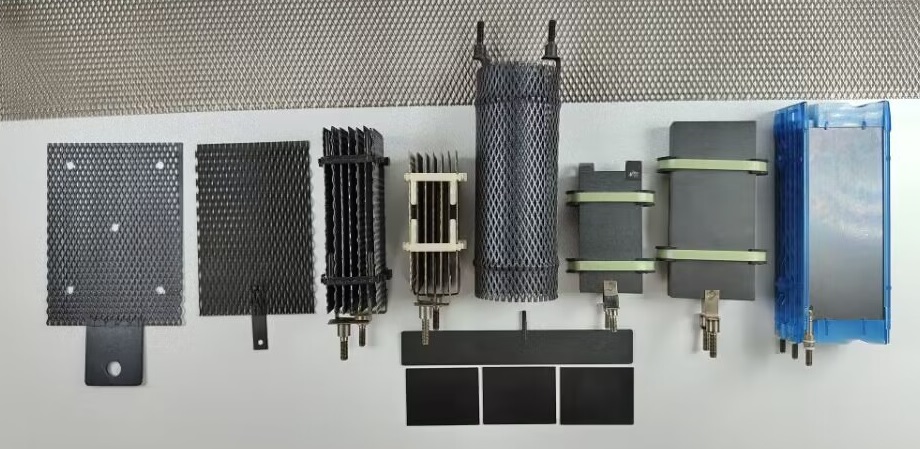
General Shapes: Plate, Rod, Mesh, Tube or customization
Coating: The classical formula of IrO2-Ta2O5, Ru-Ir, Pt, or customization
Electrochemical reaction: Oxygen/Chlorine/Hydrogen evolution reaction
Internal Code: NAVI-1-001
Brand: NAVI Titanium®
Basic Material: Pure Titanium Gr1
Advanced fields of NAVI: PEM, PCB, wastwater treatment etc.
2.Purchasing guide
(1)Process
NAVI Titanium(since 2008) can process according to your design drawings
(2)Free sample
NAVI Titanium supply free sample for general specifications
(3)Technology support
Professional one-for-one service, design free, welcome to contact us
MMO Titanium Anode vs Platinum Titanium Anode: Coating and Processing Differences
MMO titanium anode fabrication applies mixed metal oxide layers via thermal decomposition. Technicians prepare titanium plates through sandblasting or acid etching for microscopic surface roughening, enhancing adhesion. Coating solutions contain iridium, ruthenium, tantalum, and titanium oxides dissolved in organic carriers. Multiple thin layers are brush or spray applied, each fired at 450–550°C to harden. This process repeats until reaching 5–15 micrometers thickness. Platinum-coated titanium anodes use different methods-electroplating from platinum salt baths creates 2–10 micrometer layers; explosive bonding physically joins 0.5–2.5 mm platinum sheets; cladding produces metallurgical bonds through diffusion or pressure.

Coating Composition Analysis
Mixed metal oxide films contain multiple catalytic elements optimized for specific electrochemical processes. Iridium oxide excels at oxygen evolution in acidic corrosion protection. Ruthenium oxide enhances chlorine evolution but shows limited stability in chloride-free anodic conditions. Tantalum oxide improves coating hardness and mechanical durability. Precise oxide ratios determine performance-chlor-alkali formulations differ from water treatment compositions. Modern MMO anodes often incorporate tin or antimony oxides for enhanced catalysis and extended service life. Platinum coatings consist of pure platinum or platinum-iridium alloys (typically 90:10) providing corrosion resistance and reduced dissolution rates during anodic operation.
Optimization of Processing Parameters
MMO titanium anode fabrication applies mixed metal oxide layers via thermal decomposition. Technicians prepare titanium plates through sandblasting or acid etching for microscopic surface roughening, enhancing adhesion. Coating solutions contain iridium, ruthenium, tantalum, and titanium oxides dissolved in organic carriers. Multiple thin layers are brush or spray applied, each fired at 450–550°C to harden. This process repeats until reaching 5–15 micrometers thickness. Platinum-coated titanium anodes use different methods-electroplating from platinum salt baths creates 2–10 micrometer layers; explosive bonding physically joins 0.5–2.5 mm platinum sheets; cladding produces metallurgical bonds through diffusion or pressure.

Material Comparison Between MMO Titanium Anode and Platinum Titanium Anode

Electrochemical Performance Characteristics
MMO titanium anodes demonstrate superior chlorine evolution efficiency with lower overpotentials than platinum under identical conditions-reducing cell voltages in chlor-alkali plants. The mixed oxide surface provides abundant active sites minimizing activation losses. Optimized oxide ratios enhance oxygen evolution performance in neutral and alkaline solutions. Platinum-coated anodes excel in applications requiring high reversibility and low surface fouling. Platinum resists organic contamination and scaling better than oxide coatings, performs excellently in acidic oxygen evolution, and withstands fluoride attack. Platinum maintains electrochemical stability across wide potential ranges, though requiring higher overpotentials for chlorine generation than ruthenium-iridium oxide mixtures.
Corrosion Resistance and Service Life
Properly manufactured MMO titanium anodes achieve 5–7+ year service lives in chlor-alkali environments. The oxide layer maintains catalytic activity while protecting titanium from anodic oxidation. Degradation occurs through coating wear and electrolytic dissolution of active components-ruthenium oxide dissolves fastest, limiting life in chloride-free environments. Platinum anodes offer exceptional corrosion resistance with dissolution rates measured in nanograms per coulomb. Well-designed systems exceed 15–20 years service life. Platinum degrades primarily through mechanical erosion or delamination rather than electrolytic breakdown. Thin electroplated layers (2–5 micrometers) may wear through after several years at high current densities; thicker clad anodes provide much longer service but significantly higher initial costs.


Economic Considerations and Cost Analysis
MMO titanium anodes cost 60–80% less than comparable platinum-coated options, making them preferred for large-scale projects requiring hundreds of square meters of anode surface. Lower material costs reflect use of relatively inexpensive oxide precursors versus platinum's precious metal pricing. Manufacturing efficiency improvements over forty years have further reduced unit costs. Platinum-coated anodes require substantial initial investment-thin electroplated layers offer best cost-effectiveness, while thick clad anodes demand significant capital. Platinum's long service life and recyclability partially offset high costs by reducing replacement frequency and providing scrap value.
Industrial Applications of MMO Titanium Anode vs Platinum Titanium Anode Performance
The chlor-alkali business uses mmo titanium anode technology most. Dimensionally stable anodes with ruthenium-iridium oxide coatings tailored for chlorine evolution are used in modern membrane cell facilities globally. The installations treat concentrated sodium chloride brines at current densities of 2-6 kA/m². The oxide coatings are stable in the severe alkaline environment with high chloride concentrations and high temperatures (85-95°C). Since its commercial debut in the 1970s, energy efficiency gains due to lower cell voltages have saved the industry billions of dollars in operating expenses. More water treatment facilities use mmo titanium anode systems for improved oxidation and electrochemical disinfection. Municipal wastewater treatment facilities use these anodes in electrocoagulation and electrooxidation reactors for refractory organic contaminants. On-site electrochemical production produces chlorine or mixed oxidants for pool and drinking water treatment.


Oxide coatings function well in varied treatment settings with varying water chemistry. Current density, water quality, and operating practices determine service lifetimes of 3–8 years. Platinum-coated anodes are used in niche applications that justify their high cost. Due to saltwater compatibility and stability, platinum anodes are used in offshore platform and marine structure cathodic protection systems. Platinum prevents catalytic metal leaking into product streams in high-purity chemical manufacturing processes with minimum electrode contamination. Platinum's electrochemical reversibility and well-characterized surface features aid lab electrochemical equipment and study. Although platinum anodes are more expensive, some perchlorate and persulfate plants continue production.
Mechanical Testing Comparison: MMO vs Platinum Titanium Anode Strength and Adhesion
Quality parameters like coating adhesion strength affect operational dependability and service life. Stress application techniques for coating-substrate mechanical bonding are tested according to standard standards. The bend test deforms coated materials while visually inspecting for fractures, delamination, and spalling. Good mmo titanium anodes can bend to 5-10 times the substrate thickness without damaging the coating. Adhesion problems usually result from poor surface preparation or heat treatment during manufacture. Tape adhesion testing quantifies coating attachment strength. Technicians apply standardized pressure-sensitive adhesive tape to the coated surface and quickly remove it at specified angles and rates. Tape pull-off coating removal percentage reflects adhesive quality. Premium mmo titanium anode goods remove less than 5% coating, whereas inferior samples lose 20-50%. This basic test checks manufacturing quality and finds processing issues.


Non-destructive ultrasonic testing detects subsurface delamination and coating density changes. High-frequency sound waves reflect differentially from well-bonded and weakly connected coated areas, forming signal patterns. Modern factories examine all production anodes using ultrasonic scanning to ensure quality before export. Pull-off adhesion testing uses bonded test studs to provide perpendicular tensile stress to evaluate coating detachment force. Quality mmo titanium anode coatings have adhesion strengths over 10 MPa, whereas platinum coatings might have 15-50 MPa depending on deposition process. Through intense electrochemical cycling at high current densities and temperatures, accelerated life testing replicates years of field use. Test techniques polarize anodes for thousands of hours and evaluate cell voltage, coating thickness, and surface morphology to assess coating effectiveness. These tests verify coating formulation, identify failure modes, and estimate field service life. Reliable manufacturers speed testing before commercializing novel coating compositions or process adjustments.
Quality Inspection Methods for MMO and Platinum Titanium Anodes Coating Consistency
A key quality control parameter impacting performance and service life is coating thickness. Non-destructive X-ray fluorescence (XRF) spectroscopy analyzes constituent element X-ray emissions to assess coating composition and thickness. Portable XRF analyzers quickly map multi-point thickness over broad anode surfaces to find coating uniformity issues that might affect performance. Thickness parameters for mmo titanium anode products are generally 8-12 micrometers with ±2 micrometer tolerance. Platinum coating thickness must be verified within deposition process limits. Microscopy shows coating microstructure, surface shape, and possible problems beyond ocular assessment. SEM images demonstrate crystalline architecture, fracture development, and coating-substrate interactions at high magnification. Integration of energy-dispersive X-ray spectroscopy (EDS) with SEM allows elemental composition mapping and oxide ratio verification. Metallographic cross-sections from precision cutting and polishing show coating layer structure and substrate contact. Quality assurance labs check manufacturing batch representative samples for microstructural uniformity.


Before shipping, electrochemical testing verifies coating catalytic activity and stability. Accelerated voltammetry scans compare overpotential findings to performance standards at standard current densities. Overpotential samples reveal coating issues that need examination and remedy. Impedance spectroscopy quantifies coating electrochemical characteristics and finds production defects. Representative samples undergo lengthy operation under simulated field circumstances to validate service life claims. Chemical analysis shows coating composition meets criteria and contamination is acceptable. ICP-OES detects small contaminants that might influence performance or durability with accuracy greater than 1%. XRD shows crystalline phases in thermally produced oxide coatings, proving calcination and oxide production. Multiple analytical methods are used in standardized quality control to create material characterisation databases for ongoing improvement.
Conclusion
Choosing between mmo titanium anode and platinum titanium anode technologies relies on the needs of the application while taking cost, performance, and longevity into account. Mixed metal oxide anodes are the most common way to evolve chlorine because they are more cost-effective, more reliable, and more efficient as catalysts. Platinum-coated options work best in specific settings that need high rust resistance, electrochemical reversibility, or long service life that makes the extra cost worth it. Knowing the ingredients in coatings, how they are made, and how to check their quality lets you make smart purchasing choices that are in line with your business's goals. The chlor-alkali industry's broad use of mmo titanium anode technology shows that oxide-based, dimensionally stable anodes work well in business. Platinum still has important special uses where its unique qualities make it more useful than its higher cost. New developments keep pushing both technology platforms forward by creating new coatings, making industrial processes better, and improving quality control methods. As industrial electrochemistry grows into new areas like improved oxidation processes, energy storage, and making hydrogen, both mmo titanium anode and platinum anode technologies will change to meet new performance needs.

FAQ
01. What is the change in mean service life between platinum titanium anodes and MMO titanium anodes in chlor-alkali situations?
02. Can MMO titanium anodes be used for the same things that platinum titanium anodes are used for?
03. How are the standards for covering thickness different for platinum titanium anodes and MMO anodes?
Partner with NAVI Titanium TECH – Your Trusted MMO Titanium Anode Supplier
When your business needs reliable, high-performance electrode options, NAVI Titanium TECH has the experience you need, along with cheap pricing and full quality guarantee. We work with 24 well-known international businesses in the pharmaceutical, electrochemical, and advanced manufacturing fields as an approved mmo titanium anode provider. Our 100,000-square-meter GMP-certified production sites keep their US-FDA, EU-GMP, PMDA, and CFDA certifications, which means they meet the highest standards for making in the world.
We ensure the quality of our products through three levels of analysis: testing in the factory, checking by a specialized QA/QC department, and getting certification from an outside authority. If any hired item doesn't meet quality standards, we'll return the full amount, which shows that we care about our customers' happiness. Our clear price system keeps profit margins steady at 10 to 30 percent, which helps build long-term relationships based on trust and shared success. Accurate wait times, clear paperwork, and full shipping help make the buying process easier. Ready to improve your electrochemical processes with high-quality mmo titanium anode solutions? Email our technical sales team at sales@navititanium.com to talk about your unique application needs and get full technical specs that are made to fit your operational parameters.
References
1. Chen, G. (2004). Electrochemical technologies in wastewater treatment. Separation and Purification Technology, 38(1), 11-41.
2. Trasatti, S. (2000). Electrocatalysis: understanding the success of DSA. Electrochimica Acta, 45(15-16), 2377-2385.
3. Comninellis, C., & Chen, G. (2010). Electrochemistry for the Environment. Springer Science & Business Media, New York.
4. Schmittinger, P., Florkiewicz, T., Curlin, L. C., Lüke, B., Scannell, R., Navin, T., & Zelfel, E. (2012). Chlorine. Ullmann's Encyclopedia of Industrial Chemistry, Wiley-VCH Verlag GmbH & Co. KGaA, Weinheim.
5. Beer, H. B. (1980). The invention and industrial development of metal anodes. Journal of the Electrochemical Society, 127(8), 303C-307C.
6. Martelli, G. N., Ornelas, R., & Faita, G. (1994). Deactivation mechanisms of oxygen evolving anodes at high current densities. Electrochimica Acta, 39(11-12), 1551-1558.



